 |
Richter
Belmont
|
 |
 |
 |
Games In and Weapons Used
Richter, like Simon, has appeared in multiple games. He first saw action in Dracula X: Chi No Rondo, or Dracula X: Rondo of Blood as the best translation, for the Turbo-Duo PC Engine. And Richter is one of the more basic Belmonts: He starts out with his whip already powered up to morning star status, and it can't be powered up by normal means; however, by pushing the item-crash button when no mystic weapon is in his possession, he can use the hearts to instead power a temporary flame whip blast. As for mystic weapons: Richter brings back the stopwatch but eliminates Juste's sacred fist from the mix:
 |
 |
 |
 |
 |
 |
|
Dagger
|
Holy
Water
|
Boomerang
|
Axe
|
Stopwatch
|
Holy
Book
|
When Konami couldn't get Rondo over to the American Turbo-Grafx CD or, at most, the SNES, they quickly threw together Castlevania: Dracula X to create the bridge leading to Symphony of the Night that we would otherwise miss. So this SNES remake is "essentially" the same game. As such, Richter starts out with his whip already powered up to morning star status, and it can't be powered up by normal means; however, by pushing the item-crash button when no mystic weapon is in his possession, he can use the hearts to instead power a temporary flame whip blast. This time around, Richter loses the holy book and sticks to the usual five mystic weapons:
|
|
|
 |
|
|
|
Dagger
|
Holy
Water
|
Boomerang
|
Axe
|
Stopwatch
|
Richter returned once more in PlayStation's Castlevania: Symphony of the Night and its Sega Saturn clone, Nocturne In the Moonlight, as both a supporting cast member and a playable character. (In Symphony, he must be unlocked. For more on how to unlock him, click here.) You'll find that he's similar in look and basic movements to his Dracula X counterparts--he has a bit more up his sleeve, though: Richter starts out with his whip already powered up to morning star status, and it can't be powered up by normal means; however, by pushing the item-crash button when no mystic weapon is in his possession, he can use the hearts to become a temporary flaming entity, where each whip slash is powered by fire. Also, like Simon and Juste, he can brandish the whip. Plus he jointly uses the new mystic weapons that were made for Alucard:
 |
 |
 |
 |
 |
|
Axe
|
Dagger
|
Holy
Water
|
Cross
|
Stopwatch
|
 |
 |
 |
 |
|
Rebound
Stone
|
Aguen
|
Bibuti
|
Holy
Book
|
Richter, ever-relishing his role of "secret character," returned for a final time in Castlevania: Portrait of Ruin as part of a two-person crew consisting of he and the Rondo of Blood version Maria Renard. Richter, though, is patterned after his Symphony skin: Richter is always in command of the Vampire Killer, bound to its long-chain form, and has at his disposal several special maneuvers; while it can't be powered up, the whip can be wildly brandished after being swung normally. Due to a lack of inventory compared to the main characters, Richter is afforded the ability to switch between six always-available sub-weapons:
 |
 |
 |
 |
 |
 |
|
Dagger
|
Holy
Water
|
Boomerang
|
Axe
|
Holy
Book
|
Cross
|
Character's History
|
What Richter didn't realize is that Shaft was more resourceful than originally thought. The dark priest survived his seeming defeat and lived to hatch a new plan: During their encounter, he cast on Richter a spell that would take effect much later. In time, it poisoned Richter's mind and coaxed him to the side of evil, removing him as an obstacle toward evil's goal of world domination. The turn was kept quiet, and to those ignorant, Richter had simply "disappeared." It was Maria Renard who set out to look for him. Sensing an imbalance tipping greatly in the favor of evil, powerful forces awakened the soul of Alucard, who rose from his slumber, braved the remodeled Castlevania, and with assistance from Maria freed Richter from Shaft's control. Despite this excusable lapse, Richter is largely recognized as one of the more powerful Belmont warriors and for a long period its last in line: In addition to perfecting the special moves, he added those character-specific like the backflip, the air dash, the spinkick, and the slide kick; he also expanded upon the process of augmenting mystic weapons by instituting the item-crash (expanding on Juste's DSS system), thereby utilizing sub-weapons to their fullest. Richter made one final appearance in Castlevania: Portrait of Ruin, where in playing his now-trademarked "secret character" role he teamed with the younger version of Maria Renard. The appearance has no bearing on the storyline and like Simon's appearance in Harmony of Dissonance is purely anachronistic (even in weapon use, where he, like Julius Belmont, had in separation both cross and boomerang sub-weapons). The speedy Richter brought to the dance all of his special maneuvers plus six sub-weapons and with Maria's help overwhelmed enemies who were glad this was all counter-reality. In Action: Dracula X Games | Symphony | Nocturne in the Moonlight |

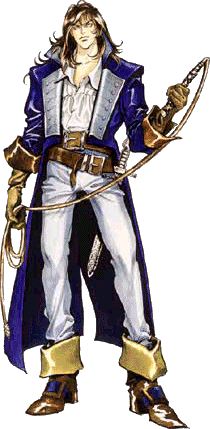 Richter's
accomplishments have made him one of the more celebrated Belmonts, and
his popularity is second only to Simon's. Though, his plight was fairly
more complex than most of the normal hunt-and-kill-Dracula Belmonts',
his burden deeper. When the dark priest Shaft plotted to conquer the
world by resurrecting Dracula and following the Dark Lord's lead, it
was Richter who bore the troubling onus. Upon his return, Dracula commanded
that his vile forces ravage the young Belmont's village and in the process
abduct his girlfriend, Annet, her younger sister, Maria, and other women
important to the village's long-term health. This act pushed Richter
over the line and within him there was instilled a sense of justice;
it was now his mission to exterminate evil's amassed army, to confront
the instigating Shaft, to arrive in time to save the women, and to put
the Count out of his misery.
Richter's
accomplishments have made him one of the more celebrated Belmonts, and
his popularity is second only to Simon's. Though, his plight was fairly
more complex than most of the normal hunt-and-kill-Dracula Belmonts',
his burden deeper. When the dark priest Shaft plotted to conquer the
world by resurrecting Dracula and following the Dark Lord's lead, it
was Richter who bore the troubling onus. Upon his return, Dracula commanded
that his vile forces ravage the young Belmont's village and in the process
abduct his girlfriend, Annet, her younger sister, Maria, and other women
important to the village's long-term health. This act pushed Richter
over the line and within him there was instilled a sense of justice;
it was now his mission to exterminate evil's amassed army, to confront
the instigating Shaft, to arrive in time to save the women, and to put
the Count out of his misery.
|
Maria
Renard
|
|
 |
 |
Games In and Weapons Used
Maria appeared in both of the Dracula X games: Dracula X: Rondo of Blood and Castlevania: Dracula X. Her role in both games was that of the supporting cast member who had been kidnapped by Dracula's dark forces. However, she was indeed a relevant playable character in Rondo who could be controlled after being saved by Richter on the game's second stage. (To find out how to save her, click here.) Maria has only one striking weapon: Small doves that she can throw forward, at short range, two at a time. In essence, each is like a boomerang in that it strikes the enemy coming and going. Maria doesn't use mystic weapons--instead, she brings along her animal friends to use as special sub-weapons:
 |
 |
 |
 |
 |
 |
|
Cat
|
Turtle
|
Dragon
|
Egg
|
Bird
|
Music
Book
|
Maria's third appearance was as a supporting cast member in Castlevania: Symphony of the Night. Maria was involved in the search for Richter, as was Alucard. Her involvement was essential to Alucard discovering the truth about Richter's sudden turn. In the Saturn version of Symphony, Dracula X: Nocturne In the Moonlight, made only for Japanese audiences, Maria is a playable character from game's start. Like Richter, she has no story elements, and her solo mission is irrelevant in the grand scheme. She relies on an magic-draining energy ball that can be charged up to three levels: (1) A bigger fireball, (2) a spherical flame, and (3) a powerful laser. Along with her other magical powers, Maria uses the typical Symphony/Nocturne weaponry:
|
|
|
|
|
|
|
Axe
|
Dagger
|
Holy
Water
|
Cross
|
Stopwatch
|
|
|
|
|
|
|
Rebound
Stone
|
Aguen
|
Bibuti
|
Holy
Book
|
The younger version of Maria Renard, as seen in Rondo of Blood, returns in Castlevania: Portrait of Ruin as the partner of Richter Belmont. Maria has only one striking weapon: Small doves that she can throw forward, at short range, one after another in rapid succession. As this attack was, each acts as a boomerang-type weapon in that it strikes the enemy coming and going. Not to be limited, Maria can switch betwen four of her previously seen animal friends, which act as sub-weapons:
 |
 |
 |
 |
|
Cat
|
Turtle
|
Dragon
|
Bird
|
Character's History
|
Among her abilities: She could double jump, crawl quickly, tumble forward at hyper speeds, project forward a deadly image to surprise foes, and, like Richter, she could utilize an item-crash-like power to supply to her animal friends super strength. Four years after the adventure, Richter mysteriously disappeared; it was the now-grown Maria who decided to set out to find him only to have Castlevania rise up from the depths as a clear invitation. The search in progress, she crossed paths with Alucard and was unsure of what to make of him. After numerous consultations and the viewing of his battles, she learned to trust him and soon took a liking to the mysterious half-breed; with this trust, she supplied him the information necessary to bring Richter to his senses. (In the Sega Saturn version, Alucard must instead fight for Maria's complete trust.) If not for her presence, Alucard may have finished off the possessed Richter and left the castle unwittingly, rendering Shaft's plan a major success. After witnessing the rescue of Richter at Alucard's hands, she ushered her brother-in-law to safety. When Alucard joined them seaside after the defeat of the Count, the infatuated Maria couldn't find the words, and she could only watch him depart; Richter sensed this feeling and urged her to act upon it, to chase after Alucard, which she did. If the two did get together, it would surely affect the balance of power as far as the increasingly powerful heroes and the ever-growing potency of their genes. Maria returned one final time in Castlevania: Portrait of Ruin, where she played the role of "secret character" and partner to Richter Belmont. This younger version of Maria, as seen in Rondo of Blood, used her dove attack, all of her special maneuvers (double jump, crawling and image projection), and four always-available animal friends to help overwhelm hapless enemies. It should be noted that her appearance is purely anachronistic and has no place in Portrait's story or the series' official timeline. In Action: Rondo of Blood | Nocturne in the Moonlight |

 Maria
was the younger sister of Annet Renard and the sister-in-law of her
husband Richter Belmont. The young girl, gifted with great magical power,
was like her older sister an unfortunate victim of Dracula's
continued assaults on Warakiya and Transylvania as a whole; specifically,
she was taken captive per Dracula's orders and imprisoned within the
castle's main halls, where Shaft would do to her as he pleased. When
Richter swooped in on the proceedings in daring fashion, Shaft fled
and left Maria to the Belmont's care. It would only seem that
way: Though only a child, Maria was more than capable of handling herself
and holding her own in battle, and she proved this by using her profound
magical abilities to aid Richter throughout the remainder of his journey;
her fiery
determination made her just as serious a danger to evil's cause. With
her strong connection to nature and a cast of animal friends, she would
overwhelm dark forces.
Maria
was the younger sister of Annet Renard and the sister-in-law of her
husband Richter Belmont. The young girl, gifted with great magical power,
was like her older sister an unfortunate victim of Dracula's
continued assaults on Warakiya and Transylvania as a whole; specifically,
she was taken captive per Dracula's orders and imprisoned within the
castle's main halls, where Shaft would do to her as he pleased. When
Richter swooped in on the proceedings in daring fashion, Shaft fled
and left Maria to the Belmont's care. It would only seem that
way: Though only a child, Maria was more than capable of handling herself
and holding her own in battle, and she proved this by using her profound
magical abilities to aid Richter throughout the remainder of his journey;
her fiery
determination made her just as serious a danger to evil's cause. With
her strong connection to nature and a cast of animal friends, she would
overwhelm dark forces.
|
Shanoa
|
|
| . |
 |
. |
Games In and Weapons Used
Shanoa is the rare Castlevania hero who is neither a Belmont descendant nor in any way related to them. Though of this distinction, she is the traditional adventure-RPG character. Using her ability to absorb "glyphs" (similar to how Soma Cruz can steal enemy souls), the at-first-limited Shanoa will channel her way to a huge arsenal of attacks--these being the usual striking weapons, projectiles and special maneuvers--that cover for three categories: Main, Back, and Sub; she can combine any three glyphs to unleash a Glyph Union, a superpowered attack that comes at greater expense. Too, she'll amass an inventory of different armor types, which will offer her increased protection against the dark forces. To view the available glyphs and armor types, please visit Ecclesia's weapon page.
Character's History
|
Barlowe then retrained the empty Shanoa and sent her out on a new mission to track down the seemingly corrupt Albus and retrieve Dominus. She managed to locate the increasingly erratic youth on a few occasions, two instances of which saw him inexplicably leave two pieces of Dominus to her care. Things eventually deteriorated to the point where she had to fight her former friend, who was overcome by darkness, in order to kill him and wrest away control of the final piece. Upon doing so, she learned the truth: Albus stole Dominus with the intent to properly control it--to protect Shanoa and find the true means of destroying Dracula, where Barlowe might have had other aspirations. She was told of this, sadly, from the fleeting Albus, who was able to temporarily live on within the Dominus glyph dwelling within her body. She confronted Barlowe about these matters and learned of his devious plot to actually resurrect Dracula using Dominus. She was forced to fight her former mentor, who before defeat sacrificed himself to ensure the Dark Lord's return. Shanoa, now having nothing left in this world, could only focus on her final mission: To destroy Dracula. Shanoa was able to defeat the Count by unleashing upon him Dominus, the price of which was her life. However, the still-lingering Albus again took her place, sacrificing what was left of his soul to Dominus, asking of the devastated Shanoa one final wish: To see her smile. Though marked by great suffering, it was with much sincerity that she granted this wish. |
 Shanoa
is one of Ecclesia's female warriors. She joined the clan at a young
age and since that point was groomed in her training to destroy Count
Dracula. Shanoa was unique amongst her Ecclesia brethren in that she
had an innate ability to channel power through "glyphs" (magical
energy representative of the power that dwells within all things), as
marked on her body, absorbing the spiritual essence of a given specimen.
So considerable was this power that Ecclesia founder Barlowe selected
Shanoa to receive Dominus, a trio of glyphs representing Dracula, altered
to be used as a weapon against him.
Shanoa
is one of Ecclesia's female warriors. She joined the clan at a young
age and since that point was groomed in her training to destroy Count
Dracula. Shanoa was unique amongst her Ecclesia brethren in that she
had an innate ability to channel power through "glyphs" (magical
energy representative of the power that dwells within all things), as
marked on her body, absorbing the spiritual essence of a given specimen.
So considerable was this power that Ecclesia founder Barlowe selected
Shanoa to receive Dominus, a trio of glyphs representing Dracula, altered
to be used as a weapon against him. Before
such a ceremony could commence, there was required a ritual that would
mentally prepare her for the harnessing of the nearly uncontrollable
power of Dominus. The ritual was interrupted by the enraged Albus, who
sought Dominus for himself; this event coincided with a violent severing
of the channeling process. Shanoa awakened from the explosive event
in an amnesiac state, her memory and emotions wiped away. The scheming
Barlowe convinced her that her loss of faculty was due to Albus' ill-intentioned
intervention, when in reality Barlowe took advantage of the incident
and sacrificed the vulnerable Shanoa's memories and emotions to Dominus
for yet-unknown means.
Before
such a ceremony could commence, there was required a ritual that would
mentally prepare her for the harnessing of the nearly uncontrollable
power of Dominus. The ritual was interrupted by the enraged Albus, who
sought Dominus for himself; this event coincided with a violent severing
of the channeling process. Shanoa awakened from the explosive event
in an amnesiac state, her memory and emotions wiped away. The scheming
Barlowe convinced her that her loss of faculty was due to Albus' ill-intentioned
intervention, when in reality Barlowe took advantage of the incident
and sacrificed the vulnerable Shanoa's memories and emotions to Dominus
for yet-unknown means.
|
Albus
|
|
| . |
 |
. |
Games In and Weapons Used
Albus, like most other unlockable heroes, is better known as a supporting-cast member who acts as a formidable boss. Taking much the same form in a now-playable capacity, Albus is pretty much your standard modern no-nonense Castlevania hero. Albus is armed with Argatha, his glyph-powered pistol, which fires magical bullets and the overpowered Max Shot. He also has at his command secondary abilities like the encircling Optical Shot and the Quadruple Ignis spinkick; accessibility moves like the warp and super jump; and thus the freedom to go wherever he pleases from game's start. Lacking inventory, he'll instead augment his power by collecting the HP, MP and Heart Max-Up symbols.
 |
|
Torpor
Crystal
|
Character's History
|
Once you clear a file in Order of Ecclesia by defeating Dracula and earning the best ending, you can then play through a more traditional mission in control of Albus, one of the more formidable unlockable heroes. His mission is of course non-canon, purely a fantasy scenario chronicling what would have happened had Albus found a way to successfully control Dominus; yet the game's map becomes populated in much the same manner as you remember from Shanoa's mission (sans the storyline sequences). Albus can quickly gain levels by overwhelming enemies with his rapid-fire pistol and Max Shot, neither much of a burden to his ever-depleting magic meter, and he'll have little trouble getting from one place to the next, what with a great number of advanced accessibility moves. Bosses will certainly serve to slow him down, but the determined youth will eventually overpower them. Soon Albus will get his wish--a chance to destroy Dracula and make this world safe for his friends and countrymen. |
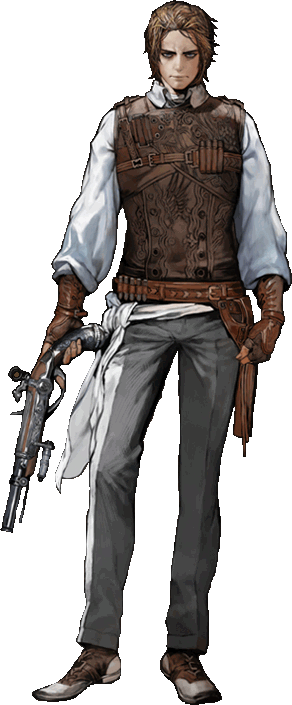
 Albus
is another of those in the long line of unlockable heroes, following
the exploits of Maxim Kischine, Julius Belmont and others. Albus' is
a tale of tragedy: He sought to keep Shanoa from absorbing Dominus,
knowing that it would likely kill her, and take her place as the bearer
despite lacking the capacity to do so, which to onlookers seemed like
the selfish act of a power-hungry youth. To the contrary, Albus stole
Dominus with only the intent of finding a way to properly harness it
as the means to destroy Dracula where Barlowe's aspirations were perhaps
something more devious.
While he was unable to discover a way to control its chaotic power,
his seemingly erratic behavior was a necessary ingredient in opening
Shanoa's eyes to Barlowe's wicked ways. Though he was eventually overpowered
by the dark energy and felled at the hands of Shanoa, he was able to
discover the path to existence beyond death, lurking within Dominus
as absorbed by Shanoa. It was in this dream-state form that he was able
to guide Shanoa, to keep her from using Dominus; when she was forced
to do so in order to destroy Dracula, he prevented her death by sacrificing
his soul in her place. She would always remember his selfless acts.
Albus
is another of those in the long line of unlockable heroes, following
the exploits of Maxim Kischine, Julius Belmont and others. Albus' is
a tale of tragedy: He sought to keep Shanoa from absorbing Dominus,
knowing that it would likely kill her, and take her place as the bearer
despite lacking the capacity to do so, which to onlookers seemed like
the selfish act of a power-hungry youth. To the contrary, Albus stole
Dominus with only the intent of finding a way to properly harness it
as the means to destroy Dracula where Barlowe's aspirations were perhaps
something more devious.
While he was unable to discover a way to control its chaotic power,
his seemingly erratic behavior was a necessary ingredient in opening
Shanoa's eyes to Barlowe's wicked ways. Though he was eventually overpowered
by the dark energy and felled at the hands of Shanoa, he was able to
discover the path to existence beyond death, lurking within Dominus
as absorbed by Shanoa. It was in this dream-state form that he was able
to guide Shanoa, to keep her from using Dominus; when she was forced
to do so in order to destroy Dracula, he prevented her death by sacrificing
his soul in her place. She would always remember his selfless acts.
|
Nathan
Graves
|
|
| . |
 |
. |
Games In and Weapons Used
Nathan Graves, the Belmont descendant, was the star of the first GBA offering of the series--Castlevania: Circle of the Moon. Nathan doesn't stray too far from the path of typical Belmonts: He starts out with a regular leather whip, but it can't be powered up by normal means; however, using the DSS Card System, he can create one hundred different magical effects, twenty of which effect the whip, and ten others that allow him to replace the whip with other striking weapons or abilities. Since there are too many to list here, you can instead find this information on Circle's weapon page. In most forms, Nathan can brandish the whip, twirling it around and around by holding down the attack button. As for mystic weapons: It's all classic Belmont, with the same weapons we know and love:
 |
 |
 |
 |
 |
|
Dagger
|
Holy
Water
|
Boomerang
|
Axe
|
Stopwatch
|
Character's History
|
In 1820, members of the Graves and Baldwin factions, led by Morris Baldwin, teamed up to accost and destroy a risen-out-of-cycle Count Dracula. After the painstaking battle concluded, the concerned Morris, having tested a sample of Dracula's true potential, took under his wing his son, Hugh, and Hugh's childhood friend Nathan Graves, and he urgently trained them in hope that they would succeed in becoming worthy of the Vampire Hunter title, that they would be more than ready to battle Dracula should he rise again and realize the potential Morris had feared. (Also, someone had to be ready in case said rising took place before the Belmonts were ready to reclaim their weapons.) The two youths served well their master and proved themselves worthy. Though, it was perceived as a shocking twist when the elder Morris decided that it was Nathan who receive the title of Vampire Hunter, as the next in the line of warriors, rather than his son, Hugh, who was clearly the superior of the two in terms of fighting skill. Nathan would vindicate Morris, whose vision was in question: When Dracula was indeed resurrected early by Camilla in 1830, it was Nathan who braved the dreaded Castlevania to defeat and thus rescue a hate-consumed, possessed Hugh, to save his kidnapped master, and to defeat Count Dracula. He proved true Morris' decision-making ability, earned the respect of the envious Hugh, and thus created a greater camaraderie between the three. Nathan was able to accomplish his mission by utilizing the DSS Card System, which was similar to the Belmonts' (or Juste's, more specifically) "Spell Fusion" and item-crash abilities, and many of the family's special fighting maneuvers, which include those both character-specific and now-mandatory: The slide, the break dash, and the super jump. |

 Nathan
is a product of Konami's director-to-director trademark swapping and
thus, in explainable story terms, the splintering within the Belmont
family tree. Still, he has relevance in regard to Richter's placement
as the "last Belmont," which was in reality a long down period
where the family was seemingly absent. In reality, there was an unknown
quirk existing when dealing with the relationship between the Belmonts
and the Vampire Killer, which the they were forbidden to command
directly until the time of the natural
cycle--the period where Dracula was risen from his slumber according
to the 100-year rule. In
the Belmonts' forced absence, they left with blood-related family members
the weapons for safekeeping should deviants try to resurrect Dracula
before the predicted date. The firsts of the blood-related families
to take on this task were presumably the Baldwins and Graves, who while
not direct in line were of comparable power.
Nathan
is a product of Konami's director-to-director trademark swapping and
thus, in explainable story terms, the splintering within the Belmont
family tree. Still, he has relevance in regard to Richter's placement
as the "last Belmont," which was in reality a long down period
where the family was seemingly absent. In reality, there was an unknown
quirk existing when dealing with the relationship between the Belmonts
and the Vampire Killer, which the they were forbidden to command
directly until the time of the natural
cycle--the period where Dracula was risen from his slumber according
to the 100-year rule. In
the Belmonts' forced absence, they left with blood-related family members
the weapons for safekeeping should deviants try to resurrect Dracula
before the predicted date. The firsts of the blood-related families
to take on this task were presumably the Baldwins and Graves, who while
not direct in line were of comparable power.
|
Cornell
|
|
  |
  |
Games In and Weapons Used
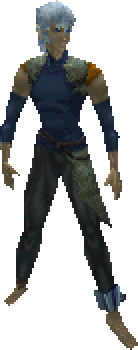
Cornell was the main hero of Castlevania: Legacy of Darkness (known in some circles as Castlevania: Special Edition). Under any name, it was the remake of Castlevania 64 that corrected some of its flaws and reimplemented many of the features that the original game was meant to showcase. Like all N64 heroes, Cornell has two striking attacks: His main attack is an energy scythe, which he can use to attack enemies at long range. This can be powered up twice by collecting morning star symbols, increasing its effect. For in-close battles, he can use his claws to swipe forward and quickly rip through enemies. These attacks remain unchanged whether he's in wolf form or not, except for the fact that they have increased strength. On top of that, Cornell also happens to command four of the usually Belmont-exclusive weapons:
 |
 |
 |
 |
|
Dagger
|
Holy
Water
|
Boomerang
|
Axe
|
Character's History
|
Cornell, the man-beast, became incensed, determined to rescue his sister and the other unfortunate victims. Cornell's were superhuman abilities: As a man-beast, Cornell was primarily a human being, but as unique specimen, he had the ability to break the ancient man-beast seal and at will assume a vicious werewolf form, a form evil had always feared. Because Cornell was the only man-beast in their order's history to have this ability, Ortega became jealous and eventually hateful of his friend, especially after Cornell by utilizing this ability proved his superiority amongst the man-beasts in a "friendly" battle; Ortega's undesirable feelings were the impetus behind his kidnapping of Ada. Cornell, through his years of training, was more than prepared for the trials that lurked ahead. He scoured the land in and around Castlevania; saved the Oldrey family's lineage by rescuing their son and future hero, Henry; and defeated Ortega, who in defeat found peace. Thereafter, he destroyed Dracula's servant, the Count's keeper, and prevented it from absorbing Ada as a sacrifice; he did this by projecting outward his wolf form, sacrificing it in her place. While Cornell was successful in his bid to save Ada and return to a life of normalcy, he through his sacrifice unwittingly contributed to what was Death and Dracula's plan all along. |

 It
was eight years before the adventures of Reinhardt Schneider and Carrie
Fernandez: Dracula's dark army and his wicked worshippers were preparing
for his return, led in the interim by their representative council,
the trio of Death,
Actrise and Gilles De Rais. This sign was all too clear when the dark
forces began to tear through the countryside and ravage towns and villages
as they always had. When Cornell arrived home after
a long period of severe ascetic training, he found his village in ruins,
a complete mess of fire and destruction; more disconcerting to Cornell
is that several town women, including his sister, Ada, had been kidnapped,
he'd learn, by his supposed friend Ortega, who looked to deliver the
women to Death as a sacrifice and as the means for Count Dracula's return.
It
was eight years before the adventures of Reinhardt Schneider and Carrie
Fernandez: Dracula's dark army and his wicked worshippers were preparing
for his return, led in the interim by their representative council,
the trio of Death,
Actrise and Gilles De Rais. This sign was all too clear when the dark
forces began to tear through the countryside and ravage towns and villages
as they always had. When Cornell arrived home after
a long period of severe ascetic training, he found his village in ruins,
a complete mess of fire and destruction; more disconcerting to Cornell
is that several town women, including his sister, Ada, had been kidnapped,
he'd learn, by his supposed friend Ortega, who looked to deliver the
women to Death as a sacrifice and as the means for Count Dracula's return.Click here for Cornell in action
 |
 |
 |
||
 |
 |
 |
||
 |
||||
 [Home] [What's New?] [CV Library] [Stages] [Reviews] [Weapons] [Castleography] [Multimedia] [Codes] [Links] |
||||
 |
 |
 |
||

