 Phantom Bat
| . |
Castlevania
& Vampire Killer
|
. |
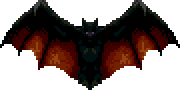
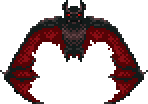
In Castlevania, it hovers above
you until coming to a halt. About three seconds later, it'll charge in whichever
direction you were standing at the time; it then retreats and repeats that
pattern. It will on occasion stop to spit out a fireball. It employs the same
basic stategy in Vampire Killer except for one difference: Every
time it comes to a halt, it spits a single fireball before charging.
| . |
Castlevania
III:
Dracula's Curse
|
. |
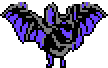
It appears twice in this game. It awaits
your arrival mid-screen and springs to life suddenly. It then begins an unpredictable
flight pattern around the area. When struck, it'll break apart into two smaller
bats, each of those breaking into two smaller bats, and so on. When it's finished
breaking apart, the smaller bats will be too weak to sustain much damage,
falling to one weapon-slash. Though small, they're still dangerous to your
health meter should you let them surround you. (The Japanese version, seen
right, is different in color and look only.)
| . |
Castlevania:
The Adventure
|
. |
This bat is actually Dracula's second
form. It flies around at the top of the screen, stopping to spit out three
smaller bats after every third trek across the screen. The goal here is to
avoid the small bats, using your whip and platforms surrounding the area,
in order to focus on the real target--Dracula!
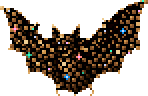
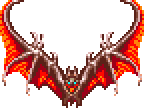
Here it appears as a creature made
entirely of gold and rubies. It flies around atop the screen, stopping to
charge, as it has in the past. When you strike it, some gold pieces will break
off of its frame, left and right, and the loose coins can damage you. When
the bat itself takes enough damage, it'll break into three smaller bats; each
smaller bat hovers well above, trying to drop single coins onto you. To make
it worse, they, too, shed gold pieces left and right when struck.
It starts off as a swarm of bats before
merging into the form shown above. It doesn't do much while in full form except
fly around the top portion of the screen. After each hit, it'll again break
into a swarm of bats--this is where its true power real lies. The group of
bats will stall for a second or two and quickly dash toward you. Afterwards,
it'll take full form and start the cycle again. It can be harmed no matter
if it's in full or bat-swarm form.
It starts out in the form you see above,
but after every hit, it'll break into a swarm of smaller bats that fly around,
bobbing up and down like a flying-mammal conga line. After crowding as much
space as they can, they'll merge together and retake full form. It can be
harmed while in whole form or in bat-swarm form. Overall: Its pattern is very
limited. However, the Rondo of Blood version can spin itself like a
top into a needle formation and drill-attack you; it can also dash and spit
heat-seeking fireballs. This version does not break into a swarm of smaller
bats when struck.
| . |
Castlevania:
Symphony of the Night
|
. |
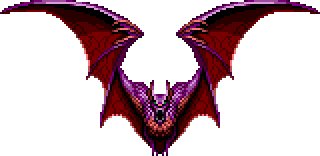
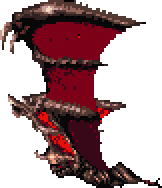
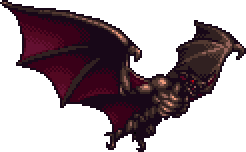
The Darkwing Bat from Symphony
isn't a typical phantom bat form--it doesn't lack for offensive abilities,
but, even so, it still remains a pushover of a foe because it takes too long
to execute them, and your attacks can nullify them before they begin.
The bat will fly back and forth, always overhead, while bobbing up and down;
this is clearly the bat using its huge frame and long wingspan to its advantage.
At any time, it will gather into either of the upper corners and begin wildly
flapping its wings, which will create strong winds that'll send Alucard crashing
into the walls. Rarely, it will execute a familiar move--it will twist itself
into a needle formation and drill-attack you by flying in sideways. Chances
are that you'll have finished it off before any of this can happen.
| . |
Castlevania:
Harmony of Dissonance
|
. |
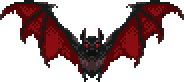
It's not a shock that this version
of the Phantom Bat (simply called "Giant Bat") takes after its Dracula
X counterparts--the same Konami team made this game, after all.
It's not as offensively-minded, however. Mainly, the bat will fly around overhead,
trying to make any kind of contact. After you strike it three times, it'll
break up into a swarm of smaller bats and reform elsewhere. If you take too
long, it can execute two types of attacks: The bat will stop to spit out a
heat-seeking fireball that'll force you to play defensively, or it'll spin
itself into a large needle formation and try to drill you into the ground.
| . |
Castlevania:
Dawn of Sorrow
|
. |
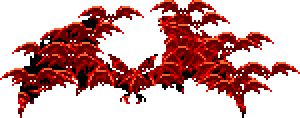
The appropriately named Bat Company,
a group of bats that thinks and acts as a single entity, is more than at home
amongst its phantom bat brethren. The relative cloud of bats, a considerable
horde, stretches a long horizontal distance, which keeps active the barely
equipped (jumping-wise) hero; the company uses this size to overwhelm and
score repeated hits. If the positioning is right, they can grab onto the hero
and rapidly drain his or her energy until an escape can be made. Alternately,
the group will assume a second, more close-knit formation, from which they'll
begin releasing in all directions a multitude of sonic rings, which, beside
serving as their own danger, further distract from the real target.
| . |
Castlevania:
Order of Shadows
|
. |
Let's be honest: The phantom bat and
its brethren, no thanks to the recurrence of such, have always had the dubious
distinction of being the bottom rung of Dracula-protecting boss guardians.
Someone or something had to be. Looking to improve their value as cronies,
they've created from their ranks the Twin Bats, adhering to the logic that
"two" is better than one. In an effort to confuse and perhaps trap
within their net a hapless hero, the bats when in motion continuously circle
each other, which discourages a close-range counterattack and punishes those
who try with the pain you'd expect from direct contact. Otherwise, the Twin
Bats will rush to the screen's side, one hovering above the other, and execute
a one-two punch: The bottom bat will spit forward a fireball before the one
positioned top divebombs diagonally downward.
| . |
Castlevania:
The Adventure Rebirth
|
. |
This form of phantom bat, your average
low-ranked grunt, is a legion of smaller bats that group together and merge
into the larger baddie you've come to expect. After cautiously flapping its
way about the room, carefully measuring your movement, the bat suddenly performs
a long-distance bat-dash (reminiscent of Alucard's Wing Smash). And, well,
that's pretty much it. When struck three times, it'll break up into
legion form and then reconfigure elsewhere. The phantom bat is easily overwhelmed,
the whole battle merely a training exercise.
| . |
Castlevania:
Grimoire of Souls
|
. |
Grimoire's version of this boss
is called the "Giant Bat," and it's pretty much an amalgamation
of all of the aforementioned. The "Wings in the Dark," as it's nicknamed,
has four attacks: It flies over to an advantageous position and then executes
a flaming swoop-attack. It twists itself into a tornado and then executes
a charging drill-attack. It breaks into a swarm of smaller bats and stalks
its target; if the swarm captures its prey, it surrounds and repeatedly batters
it. And it moves offscreen before executing a four-step charge attack: three
small bats dart across the screen in succession, and then the fully formed
Giant Bat, itself, does the same.
Back