 Spotlight Stealers
As if the Belmonts weren't busy enough in their ever-continuing mission of countering Count Dracula, Konami has called upon their services for a great number of other ventures. Too, Konami has made many cameo-rich games that have never seen the light of day in the United States or Europe. A few of Konami's Japanese-only games were unique in that they were either mascot-mashups or obscure concepts that exploited the presence of these mascots for marketing purposes. Such games, of course, were likely to include characters from the Castlevania collection as well as castle structures and elements ripped right out from the series' many games. These pages will detail those titles and any others that utilize the services of the Belmonts plus other heroes and villains of Castlevania.

|
Select Your Page
|
[Hai no Majutsushi] [Konami Wai Wai World] [Wai Wai World 2] [Kid Dracula] [Ganbare Goemon 2] [Gokujou Parodius] [Battle Tryst] [Konami Krazy Racers] [DMTV: World Fighters] [Konami WaiWai Sokoban] [Eternal Knights 2] [New International Track and Field] [THE-BishiBashi] [Hirameki Pazuru Makkusuueru no Fushigina Nohto] [Orecabattle] [Super Smash Bros. Ultimate]
[Castlevania References] [Borrowed Elements]
 |
Date Released
|
System
For
|
Disk Size
|
|
1989
|
MSX2
|
128KB
|
|
|
Main Heroes
|
Box Cover
Scan
|
Manual Scan
|
|
|
Konami Mascots
|
|||
|
Castlevania Opponent:
Simon Belmont
|
|||
 |
|||
What do you do when you're a well-known video-game company and you're unsure about the drawing appeal of your newest project? Why, easy--you throw in a bunch of your famous mascots and use their inclusion as one of the main selling points. Konami did this with Hai no Majutsushi, a mahjong game that was released only in Japan for the MSX2 computer system. Included in Hai no Majutsushi are eight such mascots.


But as you may have surmised, no cast of Konami mascots would be complete without the inclusion of Simon Belmont, Castlevania's most recognizable face. As shown on the game's introduction screen, Simon joins forces with such heroes as Goemon (Legend of the Mystical Ninja), Dr. Venom (Gradius), Moai (Gradius) and Pentaro the ever-present Penguin to play a little game of mahjong. Why this troupe is gathering to partake in such an activity is inexplicable, but not as much as the manual's profile of Simon, which has the famed vampire hunter listed as a "hentai" (pervert), describing the years following his legendary adventures.


Whatever the case, the video-game contemporaries will actually compete against each other. On the game's menu screen, you can pick the three opponents against whom you want to play; furthermore, you can adjust each of the opponents' statistics in seven categories, if need be, to set a handicap or make the game more challenging.


The goal of each game is to complete a hand, which entails four sets of three (or four) tiles in a suit plus an identical pair of any suit. This can be done in individual sets, triplets or quadruplets (identical), or in sequence (1,2,3; 5,6,7; etc.). For more information on how to play mahjong, check this website for details. (Thanks to Enrico De Castro for this information.)
 |
Date Released
|
System
For
|
Re-released
For
|
|
1/14/1988
|
Famicom
|
Cell Phones
|
|
|
Cartridge
Size
|
Main
Hero
|
Packaging Scans
|
|
|
256KB
|
Konami Man
|
||
|
Playable Castlevania
Hero: Simon Belmont
|
|||
 |
|||
Konami Wai Wai World, unfortunately, was another title only made for Japan audiences. The mascot-driven Wai Wai World has an expected story: It seems that someone or something has infiltrated the world of Konami, has teamed up with its major villains, and has with their help taken captive of all heroes from Konami's most popular franchises. It's up to the game's protagonist, Konami Man, to travel to each world and save the heroes from the head villains' captivation. One of those worlds he has to travel to: Castlevania.


Konami Man enters the world of Castlevania only to find himself in those familiar castle halls. Skeletons, bats, slimes, spiders, mud creatures, fishmen, hunchbacks and other monsters will try to stop Konami Man from locating the key that opens the casket containing the incarcerated Simon Belmont. Deep in the castle basement, Konami Man runs into a large one-eyed creature that hops around on two legs. Helped by the ability to transform into an android--his counterpart Konami Lady, a creation of resident genius Dr. Cinnamon--Konami Man is able to defeat the creature and earn himself a key.


|
|
 As
he heads back to the main hallway, Konami Man runs into the ultimate
evil of the Castlevania universe--Count Dracula! Dracula, in classic
fashion, teleports in and out, all around the room, firing at our hero
his 3- to 5-directional fireballs. (Defeating Dracula isn't necessary,
though--you can pass him right by and head directly to the left, where
Simon is being held captive; however, if you don't eliminate Dracula,
he'll continue to tail you and make the trek over the many bottomless
pits incredibly inconvenient.) Once Simon is free, he'll jump for joy
and furthermore pledge his support as an ally, who you can then switch
to at any time. Simon controls just as you'd expect, with his famed
Vampire Killer whip in hand and a throwing-cross sub-weapon, which can
be put to use after you find the well-hidden mystic item. With
Simon rescued, you'll have at your side an ally strong against vampires.
Making the playing experience all the more authentic, Simon even comes
with his own theme music, Vampire Killer, which will play whenever
he's in action. Simon's burden is now Konami Man's; it's now his
mission to save the other captured heroes. To view additional media,
including the aforementioned theme music, click on the links below.
As
he heads back to the main hallway, Konami Man runs into the ultimate
evil of the Castlevania universe--Count Dracula! Dracula, in classic
fashion, teleports in and out, all around the room, firing at our hero
his 3- to 5-directional fireballs. (Defeating Dracula isn't necessary,
though--you can pass him right by and head directly to the left, where
Simon is being held captive; however, if you don't eliminate Dracula,
he'll continue to tail you and make the trek over the many bottomless
pits incredibly inconvenient.) Once Simon is free, he'll jump for joy
and furthermore pledge his support as an ally, who you can then switch
to at any time. Simon controls just as you'd expect, with his famed
Vampire Killer whip in hand and a throwing-cross sub-weapon, which can
be put to use after you find the well-hidden mystic item. With
Simon rescued, you'll have at your side an ally strong against vampires.
Making the playing experience all the more authentic, Simon even comes
with his own theme music, Vampire Killer, which will play whenever
he's in action. Simon's burden is now Konami Man's; it's now his
mission to save the other captured heroes. To view additional media,
including the aforementioned theme music, click on the links below.Other Media
Re-Releases
 Konami
in 2006 re-released Wai Wai World for Japanese cell phones, as part
of its continuing i-mode action-adventure series. Like its Akumajou Densetsu
release, this version of Wai Wai World is very much faithful to the
Famicom classic. In comparison to those seen in its Famicom counterpart, the
graphics' color-schemes are what I'd describe as washed-out-looking. Still,
it apparently plays as well as can be expected for a cell phone game.
Konami
in 2006 re-released Wai Wai World for Japanese cell phones, as part
of its continuing i-mode action-adventure series. Like its Akumajou Densetsu
release, this version of Wai Wai World is very much faithful to the
Famicom classic. In comparison to those seen in its Famicom counterpart, the
graphics' color-schemes are what I'd describe as washed-out-looking. Still,
it apparently plays as well as can be expected for a cell phone game.
 |
 |
 |
 |
 |
 |
 |
Date Released
|
System
For
|
Cartridge
Size
|
|
1/5/1991
|
Famicom
|
384KB
|
|
|
Main Hero
|
Box Cover
Scan
|
Manual Scan
|
|
|
Rickle
|
|||
|
Transformable Castlevania
Hero: Simon Belmont
|
|||
 |
|||
In Wai Wai World 2: SOS!! Paseri Jou (Parsley Castle), the sequel to Konami Wai Wai World, a new major villain has mysteriously arrived in the world of Konami. Having learned from the mistakes of the last deviant to try this stunt, he gains an edge by kidnapping a woman of great importance--the princess of Konami World. Dr. Cinnamon gets right to work and relays these happenings to Rickle, his robot creation, who will take on the rescue mission. Where the original game had a character-switch mechanic and continued access to the full roster, Paseri Jou gives the main hero, Rickle, the ability to transform into Konami heroes--mainly the random trios selectable from game's start menu.


Of course, three of the available sets include the most popular hero of Castlevania--Simon Belmont. You won't be able to play as Simon as often as you could in Konami World due to the game's main gimmick, which dictates that the name-brand heroes can only be controlled for a limited time after Rickle collects a special power-up that allows him to take the form of any such hero.


You'll eventually reach a Castlevania level (as part of World 9, which you can reach using the code shown in the leftmost screenshot above), where you'll traverse a graveyard, a chapel, and finally the main halls, all the while battling vampires, fishmen, Medusas, Frankensteins, wolfmen and many other weird, twisted creatures before facing the boss--a possessed casket with a mean right hook.


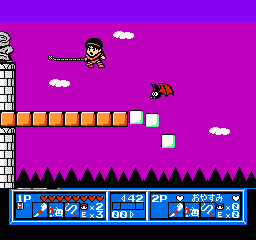
You're basically invincible when you transform into a Konami hero, but when the allotted time is up, you'll be hastily switched back to control of Rickle. As for Simon: His control scheme is mapped as expected. He'll at first be bereft of any sub-weapons but immediately in command of the famed Vampire Killer whip, which will more than suffice. If you'd like to stretch out the clock and remain as Simon as long as possible, you'll have to keep collecting power-up symbols and pushing "up" plus "attack" when the cycling box-slot highlights the whip symbol. Every time you're struck by an enemy, the clock time decreases by about ten ticks.


You'll trek along to Wai Wai World 2's version of Vampire Killer, which plays for the first half of the stage before the tune switches to Bloody Tears. When you face the bipedal coffin boss, the tune Black Knight (heard during the final boss battle in Castlevania) will play. What's Simon's reward for once again contributing to a greater cause and helping to secure the future of Konami World? Not much--just another quick mugshot in the credits.
Other Media
 |
Date Released
|
Systems
For
|
Cartridge
Sizes
|
|
10/19/90
|
Famicom
|
256KB
|
|
|
Main Hero
|
Box Cover
Scan
|
Manual Scan
|
|
|
Kid
Dracula
|
|||
|
Playable
Castlevania Hero: Kid Dracula
|
|||
 |
|||
Unbeknownst to most, Count Dracula has his very own satirical Castlevania-like game for the Famicom in Japan and for the Game Boy in the west. The Japanese version is titled Akumajou Special: Boku Dracula-kun, while the Game Boy entry is named simply Kid Dracula. Let's start with the Famicom game: The game's intro shows the young vampire staring up at the moon, which quickly transforms into the head of the dinosaur-like creature named Garamoth (no doubt the predecessor to Galamoth from Symphony of the Night). While nothing is ever said, we can say with certainty that this Garamoth fellow is an enemy of young Dracula.
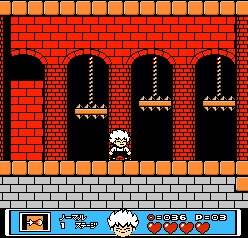

There are no real surprises gameplay-wise; the adventure and solving of this mystery sees Dracula travel through the familiar castle and its surroundings (look at this castleography-like setup for the castle keep, as sent in by Nicholas@NeoPalace.zzn.com) and battle familiar enemies, like zombies, bats, knights and Frankenstein monsters--but this only the start of the tale. Following the introductory stage, the game takes us to the sky, to amusement parks, underwater, onto pirate ships, across city skyscrapers, atop a moving train, and finally into Garamoth's fortress. You'll notice that many cultures and groups are parodied along the way, some subtle jabs taken.


Dracula's weapon of choice is his ball of destruction, but he can only throw one at a time; he can, however, charge up the attack and unleash a bigger, more powerful fireball, and he can do this in four directions--left, right, up and down. As he defeats bosses, he'll also attain (remember) other abilities. Among them: He'll be able to fire five-directional homing balls; he'll gain an explosive-fireball ability; he'll be able to temporarily turn into a bat, to fly over obstacles; he'll be able to fire an immobilizing ice shot; and he'll gain the ability to walk on ceilings.
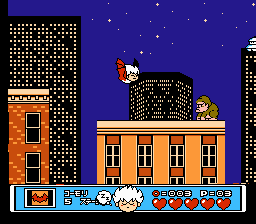


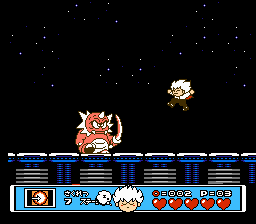
Boku Dracula-kun is a very difficult, maddening game, and you'll recognize many of its vile tricks and traps from right out of the Castlevania playbook. You'll also wonder about the sanity of the people who made it. The madness will come to a head when you eventually reach Garamoth (seen in the screenshot directly above and to the right of this text) for what isn't the game's final battle. Rather, you'll find that there's a higher power at work--Garamoth's even meaner-looking superior, a dragon with devastating electrical power.


In the end, Dracula will finish off this major threat and return to the castle, where his cavalcade of monsters await their leader.
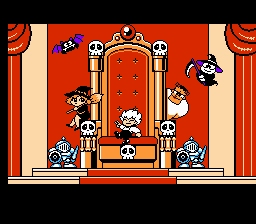
For more information--including screenshots, packaging scans, character lists, and more--please visit its game page.
The Game Boy Title
The Game Boy version, which was released three years later, is simultaneously a remake and a sequel. It's altogether similar in look, stage design and mechanics but a bit different in that the story is more refined: It seems as though Garamoth is back and threatening to head up his own army, and several of Kid Dracula's allies have already jumped sides. But the Count still has some loyal buddies, including the Grim Reaper and other wacky creatures (like a crew of bats), who will help Kid Dracula, their master, along the way. You'll find some other surprises in this version that didn't exist in the Famicom game, like the Jason Vorhees-inspired foe positioned as a wicked boss when before it was your average minor enemy. While typical of most NES-to-Game Boy conversions, you'll actually find this to be the more polished game.
For more information--including screenshots, packaging scans, character lists, and more--please visit its game page.
Re-Releases
Additionally, Akumajou Special: Boku Dracula-kun is another included in Konami's growing library of cell phone games based off of its 8- and 16-bit classics. Released in 2006, this i-mode special is another faithful rendition (of the Famicom version, obviously) featuring our old pal Kid Dracula, and it's as of now only available to Japanese cell phone users.
Read more about it and see screenshots (in the "Media" section) on Akumajou Special: Boku Dracula-kun's game page.
Page 2: More Cameos | Back to Heroes | Back to Games
 |
 |
 |
||
 |
 |
 |
||
 |
||||
 [Home] [What's New?] [CV Library] [Stages] [Reviews] [Weapons] [Castleography] [Multimedia] [Codes] [Links] |
||||
 |
 |
 |
||

