 Werebeasts and Animals
I:
Mutated Animals
Through heinous experimentations
of evil in a Castlevania lab or by the insidious nature of the castle's dark
influence, certain mammals and sea life have mutated into human-like forms,
more vicious and undaunted than they could ever be in their usual form. For
some, advanced fighting skill comes naturally.
The Arachnes
are the two-dimensional answer to Castlevania 64's spider women of
the same name. Though logically in possession of advanced speed due to a greater
number of limbs, Arachnes prefer to methodically patrol over a marked territory;
they'll react to any intrusion in this space by spitting onto the target a
mobility-crippling web. Flesh-hungry Arachnes will otherwise expel a poisonous
mist.
|
|
Alternate Names/Forms:
Spider Woman |
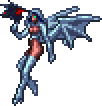
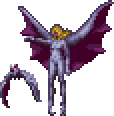
Bat women are
either the wretched result of the demonic breeding of vampire bats and human
women or a winged mutation specific to a certain breed of female vampire.
There are two known forms: The Werebat, an elusive half-female, half-bat that
avoids combat and leaves the assault to its conjured bat friends; and Draculina,
a flight-happy vampire who also conjures bats but will otherwise fly overhead
and deliver to foes below a two-step mule kick.
These recurring foes are
based on the mutated monster seen in The Creature from the Black
Lagoon. As fellow denizens of the deep, they populate rivers and streams
inside, beneath, and outside the castle. Fishmen and mermen are known to
pop out from their habitat unexpectedly, their movement on land bipedal;
after emerging from the deep, they'll spew fireballs, poisonous streams
of water, or even deadly mist before retreating back to their habitat. Certain
breeds of merman get more physical, throwing punches and diving at their
target; their advanced forms can release electrical currents and spit acid.
|
|
Alternate
Names/Forms: Electric
Merman and Hunter Merman |
It's the Castlevania
version of Robin Hood, I suppose. These sly foxes will rest in corners and
other difficult areas with their bows and arrows ready for bear. When the
hero draws near, they'll fire an arrow through the air--where it lands, they
do not care. The advanced versions
are called Fox Hunters, and they're more efficient than the archers. These
cool customers can quickly fire an arrow forward, reach back for another one,
and fire again within seconds. Both versions' strength is amplified when paired
with other archers or with airborne lesser enemies.
This is obviously
some sort of take on Freddy Kruger of A Nightmare On Elmstreet fame.
These mutated wolverines, with their sharp claws outstretched, move quickly
and suddenly lunge forward for an even speedier assault. This makes the
other lesser enemies around them, mainly skeletons, more of a threat as
a result.
Initially your
average tiny, defenseless bats, these giant terrors grew disproportionately
as they drank the blood as supplied to them by their new vampire masters.
Now dangerous predators, they feed upon the creatures that were once their
predators. Giant bats, when grounded, will throw punches and execute charge
attacks; from the air, they'll instead unleash a dive-bomb attack.
Hyenas, mutated
carnivorous mammals, are a combination of a Bone Musket and a Fox Archer/Hunter.
They'll stay in their crouched position and load up their rifles. When you
get close, they'll temporarily change colors to signal a blast. After firing,
they must reload, which gives you more than enough time to counterattack.
These advanced
fishmen lie in wait in dank caverns. When you get close, they'll begin jumping
to and fro while chucking daggers diagonally downward, two at a time, each
at a different range. While the creature may seem intimidating, your best
chance for success is to stay close to it.
Ladycats
are half woman, half monster terrors that toy with their prey with evasive
movement,
quick dives and finally
a lights-out claw-swipe. The advanced form is known simply as "Black
Panther" (which speaks little of its actual pedigree), a black female
panther who is very much humanoid but like the Ladycat moves evasively on
all-fours, setting up its quick dives and claw-swipes.
These mutated
lizards are especially trained in combat with a sword. There are five known
forms of them. They are, from left to right:
Merman may enjoy
hunting those who dare tread near their domain, but some have an ulterior
motive. Namely, they have families to feed. After disabling their victims,
they toss the live habitants down to their offspring below the surface. These
merman tadpoles charge toward their animate prey, ramming them blunt force
before frying them using their innate power of electrocution.
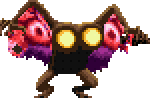
This half man,
half moth is a mysterious if not only "rumored" to actually exist.
It surely does, and when it makes its presence known after tracking down the
strongest of light sources, it will fly around and jump about while dropping
down from overhead a poisonous powder.
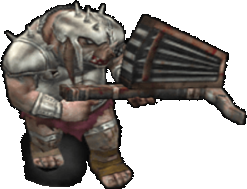
Orcs
are pig-like monsters that operate in packs and attack by firing burning
arrows from long distances. There are two advanced forms: First we have
the sniper orcs--handpicked individuals who were awarded high ranking due
to their superior skills with crossbows; their kind fires three successive
shots. And then there are the top-ranked rapid snipers, who employ rapid-firing
blowguns that can mow foes down.
|
|
Alternate
Names/Forms: Sniper
Orc & Rapid Sniper |
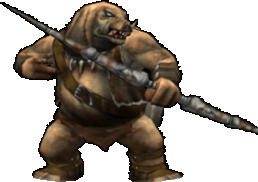
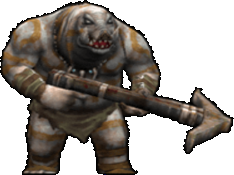
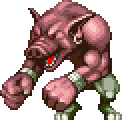
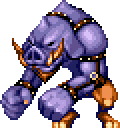
These boar-like
creatures are as bulky as they are nimble. They are described as savage men
that kill with their bare hands. That is, they hope around anticipating openings
within which to unleash a punch or an uppercut. Otherwise, they can spit large
fireballs straight ahead. The stronger versions,
known to exhibit exceptional fighting skill,
are Hell Boars; this form can instead spit large fireballs in arcs.
As if a regular
bears aren't tough enough, these mutated mammals can crush a few skulls. Slow
but powerful, they'll lumber in hope of getting close enough to unleash a
fierce claw-swipe that'll send you flying far back. If you stay at a distance,
you'll have a fighting chance. The
stronger versions are mutated polar bears, and, though tougher to defeat,
they use the same type of offense. A rare form of were-bear, the abomidable
snowman iteself, prefers to avoid any form of combat for the sake of its own
"unseen" legend.
|
|
Alternate
Names/Forms: Yeti |
Were-cats come
in two different power levels: The medium-leveled were-panthers and the stronger
were-jaguars. As mutated members of the wildcat family, they'll cleverly bounce
around in place and, at timed intervals, speedily dash forward with right
hooks. Their strength is amplified when grouped together with other lesser
enemies.
|
|
Alternate
Names/Forms: Weretiger |
It seems as though
there are no animals that Dracula's forces haven't experimented upon. As another
mutated were-beast, this sledgehammer-wielding foe will unrelentingly dash
forward, crashing said weapon into the ground; every time it does this, debris
from the ground will fly forward; you'll have to dodge each piece accordingly
before the next barrage comes your way.
There are those humans who
voluntarily or involuntary shapeshift into werewolves under the influence
of a full moon. Werewolves are generally highly athletic and like to pounce
on foes with lunges and high jumps; sly and calculated, without conscience,
they like to pick apart enemies with a variety of claw-swipes. Too, they
are likely to appear in large groups. The Lycanthrope-named assortment function
much the same, their "greater," pureblooded variety utilizing
midair claw-swipes and slice-backhand combos.
|
|
Alternate
Names/Forms: Wolfman,
Lesser Lycanthrope, Greater Lycanthrope, Shadow Wolf & Divine Wolf
|
II:
Animal Kingdom
The onslaught of evil certainly
isn't relegated to the undead. Through their predatory and territorial nature,
animals become a natural danger en route to the castle. Birds, lizards and
the other wildlife don't have special powers, but their natural abilities
are enough for a formidable attack.
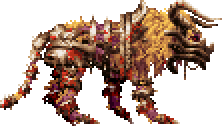
The
ferocious Armored Beast, another in the Count's long line of half-rotted castle
guardians, has equipped on all four limbs steel claws. The considerably large
beast will slowly stalk a castle intruder and attack by either kicking its
legs or by standing upright before crashing down, its front claws stirring
up a deadly sonic blast.
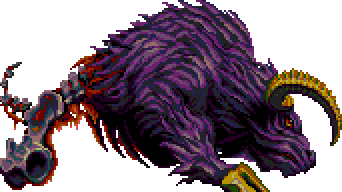
This war-ready
demon bull has already begun rotting, but it's not ready to leave this plane
just yet. Instead, it'll drag its exposed skeletal frame and chase you down
slowly, and it'll use its horns to plow down anything--hero or enemy--in its
path. It'll eventually do itself in by falling into a pit or by unwittingly
ramming itself into a wall.
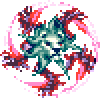
Buer is a strange
five-legged lion. By extending its legs outward in all directions, it can
form a large circle and roll. Buer will utilize this ability by rolling across
the surfaces and, especially, down the slopes of the maze-like structures
of the castle, blocking the way forward and damaging heroes. Stronger versions
of this enemy, which are referred to as "cunning demons," are called
Bael. The largest of their kind, called "Decarabia," slowly circle
watery caverns, clogging up narrow passages; contact with this specimen will
result in a poison state.
|
|
Alternate
Names/Forms: Bael
& Decarabia |
Chronomage
is something you'd expect to see rushing its way through Wonderland. This
strange castle habitant will instead play time games with you. Its
only purpose is to prevent your entrance into a certain castle area by immediately
turning back time upon sight--to force you back one room. Only those who
can stop time can eliminate it.
This odd-looking
fowl is perhaps trying to land the top spot in the most-cowardly-Castlevania-enemy-ever
category. At the sight of a hero, it'll drop to the ground and immediately
retreat in the opposite direction. If it has any special abilities, it probably
won't live long enough for you to find out.
These large birds
of prey serve one purpose: They fly in from above to serve as transportation
for the hunchbacks, fleamen and gremlins, which they'll try to drop onto your
head. Later in the series, they lost this job to the Harpies.
|
|
Alternate
Names/Forms: Altair |
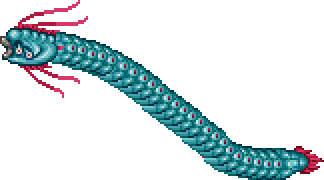
Edimmu,
the spirit of a person who did not receive a proper burial, manifests itself
as a snake-like creature and takes to the sea in search of a new host. The
poison-inducing creature swims erratically and through its maddening movement
effectively safeguarding its vulnerable head. Still, Edimmu can be taken
apart, piece by piece, with a well-placed strike proving instantly fatal.
While not the
most powerful enemy you'll ever face, they're mostly programmed to be a hindrance.
Leeches prefer to hang around the swamps and marshland, and they'll gather
into marsh pits and lunge themselves high into the air to impede your progress
so that you'll sink and burn.
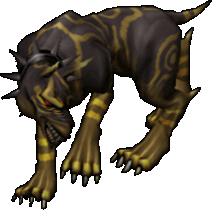
These
undead hounds are tasked with guarding the entrances to the underworld. Basic
hellhounds gives chase to trespassers and are known to dive at them or scorch
their flesh with flaming breath. There are three advanced forms of hellhound:
First there are shadow wolves, which can liquefy themselves and thereafter
travel along the ground in a pool and suddenly pop up for surprise attacks.
Then there are fenrirs--guard dogs of Hell that travel in packs and dive at
trespassers with their fangs bared. And finally there are armored sprinters--powered-up
wolf-like monsters that wear spiked armor and spew ultrasonic blasts from
their mouths.
|
|
Alternate Names/Forms:
Shadow Wolf, Fenrir & Armored Sprinter |
| . |
Leopards
and Panthers
|
. |
These members
of the cat family are the ideal choice to guard the entranceways to the castle.
The sight of intruders will cause them to spring up and give chase, jumping
high overhead to misdirect your whip strokes. Advanced forms have the magical
ability to turn themselves into sludge, tread along the floor, and reform
suddenly.
|
|
Alternate
Names/Forms: Black
Leopard |
You'd be mad
if you were mutated, too. These cold-blooded mutants, having reached this
state from the castle's dark influence, populate the mud pits of the surrounding
marsh land, waiting to dine on any pests that draw near--or, in this case,
a hero. They'll dive out from the mud, sometimes with repeated jumps, and
lash their poisonous tongues in hopes of filling that need.
|
|
Alternate Names/Forms:
Toad |
The moa is a long-legged
flightless bird whose quick-moving appendages allow it to cover a fair amount
of ground in a short period, the means using which it single-mindedly marches
forward to accost the hero. When struck, the moa will be sent hurtling back,
safe from repeated blows. It regroups by using its noted agility to dive
overhead for a more effective attack.
As are all Castlevania-dwelling
vermin, the mutant rat is another creation of the castle's dark influence.
This oversized rodent like its smaller cousins is highly aggressive and
attacks on sight. When its marked territory is breached, it'll quickly pounce,
smothering the hero with its basic movements and its difficult-to-counter
high jumps.
It's just your
basic nocturnal bird of prey. Owls prefer to stay out of sight, hiding behind
trees and bushes while peeking out, waiting for their prey to come hopping
along. When something is in their sights, they'll suddenly emerge and swoop
down with their claws outstretched.
These birds of
prey are synonymous with death. They lie in wait atop trees or castle structures;
when you come near, they begin swooping about in all directions, parrying
at a distance, before darting in your general direction. Birds become more
of a nuisance when encountered in large flocks.
Rycuda is a monstrous
bird that wields lightning. Mainly, like the ravens and crows from games past,
it will parry at a distance and fly (or attempt to fly) to out-of-reach places
from where it can generate electricity and fire down, diagonally, a highly
damaging bolt of lightning.
These long
limbless crawling reptiles are mostly to be found traveling in packs, slowly
maneuvering forward, either nested somewhere along the surface or hanging
from a ceiling structure. Some packs can drop down single snakes that pile
up and crawl along the ground to muddle up a walkway.
|
|
Alternate Names/Forms:
Viper Swarm, Snake & Poison Worm |
Bats are the
most numerous and enduring foes throughout this series. The normal pattern
of these small flying mammals is to fly in from off-screen in a waving flight-path,
at timed intervals. Other times, they cling to surfaces and wait for you to
come near before lunging in your direction.
This flesh-eating
mutant patrols the air, seeking to land its next meal. Its first instinct
is to dart down at its
prey, using a hard-to-avoid swoop-attack,
and land a surprise blow. Hit or miss, a now-grounded vulture will soon reveal
its bipedal form, taking to two legs to continue the assault.
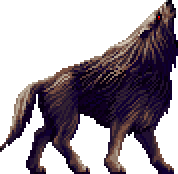
Wargs are large snowy mountain
wolves that guard the halls of Castlevania. Intruders will be greeted by
sharp-toothed jaws lunging toward them. The stronger versions are called
Fire Wargs, and they add the ability to breathe flames. Wargs are sometimes
mounted by guardian armor to become Warg Riders.
|
|
Alternate
Names/Forms: Fenrir
& Ice Warg |
The warthogs'
genealogy been kept secret among goblin tribes for centuries; the process
entails special breeding and feeding and large helpings of shamanistic magic.
Controlled by their goblin masters, warthogs charge toward the riders' targets
and ram them with their large horns. Warthogs bereft of goblin control can
be mounted and used as transport.
III:
Sea Life
There's no question that you'll
sooner or later have to traverse lakes, rivers or other large pools of water;
it's in these dangerous waters where you'll have to storm through the none-too-hospitable
sea life. As with regular animals, they'll use their instinctive nature to
protect their habitat while looking to make a warm dinner out of you. Some
sea creatures have even adapted to life on land.
These slithery
eels make a living out of circumventing platforms and castle rooms, much like
the brainless Balls of Destruction. The only difference is that these use
their natural electrical property, flashing it on and off. Contact with them
during an electric flash will cause more damage, especially within water.
These brainless
urchins spend their short, pointless lives stuck to a surface, which they
circle forever. Their spiky exterior will prove harmful, and they're just
about invincible to boot--attacking them is pointless. In the end, they serve
their purpose well: To slow down your progress and make platform-jumping a
nightmare.
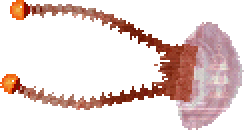
These jellyfish
creatures flop around through the air, looking ever so frail. When damaged,
they'll break apart and release their many poisonous seeds in either direction.
The smaller seeds are otherwise just as harmful as the whole pod. The larger
balloon pods always remain stationary as they hover, and they instead break
into several smaller balloon pods.
|
|
Alternate Names/Forms:
Balloon & Big Balloon |
Attacking in
groups, these slow-moving octopi gather up into large gaps to prevent your
progression. To fend off the enemy, they spray oil in all directions to further
shield themselves. This attack is more prevalent when many of them emit oil
at the same time.
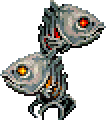
These are best
described as an underwater version of Bone Pillars. Rather than fireballs,
each of the scaly fish heads instead spit out rays that cause small sonic
waves through the water. These are surprisingly more deadly than their bone-headed
counterparts.
This demonic
sea creature comes directly from the oceans of the underworld. Its most notable
attribute is its size, which it uses to crowd the immediate area as it floats
through the air, its long tentacles flailing about. Because forneus is large
in size, it's also a big target, and it isn't much of a threat unless it's
paired with a few aggressive minor enemies.
This bizarre-looking specimen
is described as a "rare water-dwelling creature" despite the strong
probability that a Dracula-hunting hero will encounter many. Its pedigree
is similar to other annoying foes': The erratically moving Gelsos appear
one after another and generally distract and clog the area. In areas they
infest, the death of one guarantees appearance of another.
These piranha-like
voracious creatures patrol small pools of water within the depths of Castlevania.
They simply swim back and forth within their habitat--when you enter into
their sight, they'll begin propelling themselves short distances to ram you,
causing serious damage.
|
|
Alternate Names/Forms:
Spearfish |
Lorelai
is a nymph, a seductive Rhine Maiden that uses its voice to lure helpless
victims to a watery grave. The part woman, part fish accomplishes its goal
by approaching the spellbound sea-traveler and spraying a poisonous mist,
the diagnosis for those unprepared a sure death.
Needles are mutated sea urchins
that float around the castle's more watery areas, each forming a large,
spiky obstacle. Many of them together magnify this enemy type's usefulness
by really clogging up the narrow underwater passages.
Naiads live in murky swamplands,
usually passive but lying inconspicuously in wait until an unfortunate
victim mistakes their limbs for branches. Once worshiped by humans, the
now-impervious aquatic predators are now known for latching onto oblivious
wanderers who they attempt to submerge and horribly
drown.
These floating
cretins behave similarly to the Bloobers from Super Mario Bros. Squid-like
in appearance, they use suction to latch onto ceilings and suddenly spring
down, whence they begin bobbing through the air. Octos are due to their gel-like
composition somewhat resistant and will escape from anything other than a
flurry of consecutive whip slashes; direct contact with a specimen will result
in the loss of twenty hearts as absorbed by the erratically moving foe.
The stinger is a swordfish-type
sea-dweller that floats along the ocean surface amidst large schools of
its peers. This carnivorous and disturbing creature is blessed with a sharp
stinger and purpose-like agility, using which it frequently dives out from
its watery habitat to snatch delicious prey or, as it may be, the hero foolish
enough to move within its path.
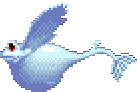
A sky fish is an animal
that escapes from its natural habitat. It flies through the air so quickly
that it's nearly invisible--only a residual flash will be seen. The only
way to see such an enemy, no less destroy it, is to find a way to slow down
time.
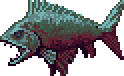
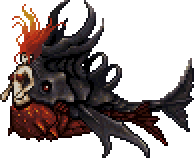
Many of these giant piranha-like
cretins patrol the waters beneath the castle's depths. They won't bother
those who stand on solid ground, but they'll instantly kill any hero who
falls or dives into their habitat. Spawns of Leviathan are impervious to
attacks and better left avoided.
Many water leapers inhabit
the watery depths of the castle's courtyard area, and they instantly make
swimming a no-no. If you walk on platforms above them, they'll dive out
of the water, sometimes in large numbers, to prevent your progression.
Once you've been conditioned to this attack, some leapers will instead
dive into the air, where they'll hover in place, turn in your direction,
and blast forward.
Page 9
| Back