 Canceled Games
|
Select Your Game
|
[Castlevania: Resurrection] [Castlevania: The Bloodletting] [Symphony of the Night - Game.com]

 |
||||||||||||||||||||||
|
|
|
|
||||||||||||||||||||
 |
||||||||||||||||||||||


The Lowdown
 |
|
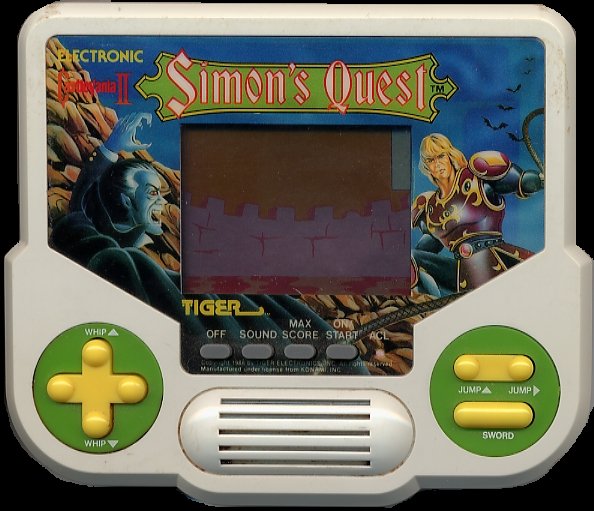
This was originally
the face of Tiger Electronics
|
History has shown that when a video game company attempts to ply its trade in the portable-handheld market by introducing a new form of hardware, it finds the move to be an increasingly bold venture. For the majority, it's tantamount to brand suicide. And it's not difficult to deduce why: Toppling the establishment is a task easier said than done. When I say "establishment," I'm of course talking about the ever-popular Game Boy and its successors. For various reasons--most assuredly the intense loyalty to the brand--consumers have yet to embrace a market populated by more than one handheld, and attempting to steal away tangible market share from Nintendo's Game Boy brand has been a fruitless endeavor for companies that have tried.
Through their creations--like the Atari Lynx, the Neo-Geo Pocket, the Sega Game Gear, the Bandai Wonderswan, the Tapewave Zodiac, the Nokia N-Gage and a few others--big-name companies have learned this lesson well. This is despite the fact that all of the aforementioned handhelds have easily out-teched and out-powered the concurrent Game Boy incarnation. The truth is that there's a certain inertia that comes from being number one, and, in the Game Boy's case, no company has figured out why it has such a broad appeal (affordability plus stable battery life, mainly) in insisting that "more power" is the key to victory. Their often arrogant dismissal of the Game Boy brand as passé has been their ultimate downfall. And while it's sometimes unfair to measure success "in comparison to," all have in the end failed in their similar goal of cutting into Nintendo's virtual monopoly on the market.
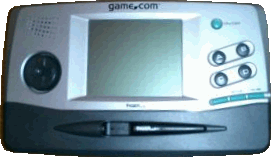
This news certainly hasn't stopped companies from trying. For an example most relevant to this site, let's backtrack to 1997, when a challenger stepped to the plate with only one mission: To become the new king of the handhelds. The company in question was none other than Tiger Electronics. "And why not?" you ask. "Who better to take the crown than the company that played a huge role in popularizing the LCD-powered handheld, the forefather of portable games?" Word spread that Tiger's new handheld, called Game.com (not to be confused with a website), would soon be hitting shelves. It would also, we learned, be sporting many advanced features, including a touch screen and, as its name suggests, Internet connectivity and capability.
 |
|
And this would have
been its new face
|
Tiger's strategy in marketing the device appeared to be a little on the sneaky side: Game.com would out-feature and out-power the Game Boy, absolutely, yet it would be relegated to a scheme of four colors--four levels of gray--to perhaps play upon the consumers' affinity for the Game Boy's more simple look and fool them into picking up Game.com in its place. Also, predictably, it would follow Sony's lead and try to combat the Game Boy by playing upon Nintendo's growing image problems; mainly, it would be marketed as a "mature" (ugh) handheld. Its library of games--which included entries from Mortal Kombat, Resident Evil and Duke Nukem--was specifically meant to pull in an older demographic.
Even more predictably, our pals at Konami were almost immediately on Tiger's bandwagon. And, to the surprise of exactly 0% of longtime visitors to this site, a Castlevania title was indeed in the works. More specifically, Konami's critically-acclaimed Castlevania: Symphony of the Night would soon be ported over to grace the system with its holy presence. This would surely be a coup for Tiger Electronics in its goal to supply its system with even more drawing power and appeal. At a gaming expo in 1998, we got our first shots of the game in action (click on an image for a larger version):
 |
 |
|
Alucard enters
the castle
|
Alucard battles
an ugly-looking zombie
|
But there was no denying the fate of an oblivious combatant, and Game.com never stood a chance. This is for three reasons:















