
 |
 |
 |
||||||||||||||||||||||||||||||||||||
|
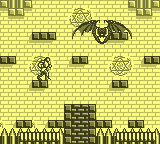
Konami in late 1989 shipped its trailblazing series over to the hottest new portable hardware device, the Game Boy, and with its short visit provided a new series entry that helped bolster the handheld's burgeoning collection of games; thus, Castlevania: The Adventure became only the third true series title to reach American shores. However, while Adventure looks the part and from a purely superficial view plays like the NES classics of yore, it's true to the series only to an extent. Konami tried to carry over a sampling of the classic series formula while redefining it in a way to make it seem anything but dumbed down, but the result of this perhaps overly ambitious task, executed by a creative force that obviously had yet to fully grasp the hardware's limitations, resulted in an unplayable mess of a game. And while Adventure often shows hints of brilliance, it falls way short because its problems are just too numerous. As if it were not already infamous enough, Adventure also marks the beginning of the series' storyline inconsistencies. Konami failed to provide its portable title any type of overarching tale, which led many publications to dub the hero "Simon Belmont" (as they tend to do for every series game regardless) in his continuing adventures. Konami corrected this only two years later when it became convenient to name him "Christopher Belmont" in light of Adventure's imminent sequel, Castlevania II: Belmont's Revenge. So it's only in deference to the fifteen-plus years of activities following that I can speak of Adventure's true hero, Christopher Belmont, the forefather of Simon by approximately one hundred years. Because of this lack of foresight, Adventure has no plot beyond the generic premise of "Belmont warrior tangles with Dracula within his dreaded castle." So Christopher must fight his way through the countryside and infiltrate Castlevania to duel with and destroy the Count as did Trevor one hundred years before. He doesn't have much in the way of arms beyond his standard leather whip, which can be powered up two levels by the absorbing of crystals found hidden in candelabras--the first transforms it into a chain whip, and a second will afford it the power to spew fireballs. You should get used to the leather whip, quite frankly, because any type of enemy contact punishes the player with immediate whip regression, one level at a time, until it's back to basic form. The game's arsenal is equally limited, and they've for some reason swapped the effects for magical items that would have been better left to player familiarity. There are no sub-weapons to be found, so the two types of hearts (regular and flashing) as such become the means for replenishing the energy meter in place of pot roasts. There's a cross that renders Chris temporarily invincible (which used to be the job of invisibility potions). There are coins, and not money bags, that increase the point-total in working toward 1-Ups, but you can otherwise earn extra lives through the location of typical 1-Up symbols. And, finally, you'll uncover large crystal that summon bosses rather than those that used to be obtained after a boss' banishment. To anyone with intimate knowledge of games prior, it comes off as if the developers tried to distinguish Adventure from its predecessors by exalting its unnecessary "adjustments," which only cause confusion in what is a weak attempt to mask and distract from the game's deficiencies. "But just how does it play?" you ask, sullenly. Simply put: It's like someone tried to fit fifteen pounds of bologna into a ten-pound bag, and you, the hapless player, are the flea larva trying to squeeze your way out. The first evidence of such is the stage design: Though the game is abbreviated in length, Konami tries to deliver a tried-and-true method of series gameplay. There are four stages loaded with Adventure's mostly unique assortment of enemies and resided over by three never-before-seen bosses plus, of course, Count Dracula. In trying to introduce fresh concepts, the developers again provide changes that are unnecessary: Rather than connecting platforms and linking to new areas by using the familiar "stairways," they provide ropes that can only be climbed at a painfully slow pace; this would have been fine had they not forgotten to allow Christopher to whip while climbing, a plight that repeatedly leaves him dead in the water any time enemies start pouring in from above and below. More infuriating is when the game turns to pure platforming: Since Christopher's jumping mechanic is unrefined and completely unmanageable, and it's very difficult to judge his current position on platforms and the distances between them due to sloppy sprite-detection, it's easy to misjudge your leaps. Do you enjoy attempting to make the same jumps over and over and over again? When just one jump over a bottomless pit is challenging enough, do you like being hit with such a challenge multiple times in succession? Well, then, you'll love Castlevania: The Adventure. While it's a pretty nice-looking game for something limited to four colors and stuffed into a 64KB pak, it ultimately earns a second strike in the graphical and mechanics department. To be fair, Adventure looks better than what you should expect from a game produced during the early years of the Game Boy's life-cycle. Its characters are nicely detailed, and present is always quality background work (like the ominous mountains, spooky woodland, dreary caverns, intimidating castle walls and other appropriate decor), but you'll be lucky if you're able to pay it any attention; it's likely that you simply won't find time while as you flee from relentless enemies and fend off never-ending streams of annoying cretins that regenerate back to position when the screen scrolls even slightly. As it was in the case of rope-climbing, Chris is on the ground hardly equipped enough to deal with the multiple enemies that tend to fly in from indefensible angles. What's most distressing about the enemy overwhelment is that it doesn't help one bit to alleviate and instead contributes to the game's most fatal flaw: The rampant blurriness and ever-increasing slowdown caused by overload; the machine simply can't process all of this information fast enough, and there's absolutely no effort made to hide it; it at all times feels like you're painfully dredging through mud while your eyes suffer in reaction to the screen's slowly accelerated, motion-sickness-inducing scrolling. It crosses the line and becomes simply unbearable when it hampers your ability to consistently tackle the game's many platforming scenarios, which would have been challenging enough even in a game where the player was content with his or her measure of control. If during this struggle we can turn our attention elsewhere and dig through to find some underlying quality, our ears will guide us to fortune; that is, our pals at Konami for a moment bucked the trend and squeezed out at least a nice soundtrack. The small collection of tunes by all means conjures up memories of the NES titles while carving its own personality and niche; the dark and moody tunes create a state of fear and provide a sense of urgency, which helps to move the game along and perhaps distract you from the fact that you're moving along at tortoise speed. When it comes to providing atmosphere, it's one of only two things they did really well. To the contrary, I don't know that I can label what Adventure has as a "sound effects" assortment, because the characters are mostly bound to silence. There's only one really ghoulish sample, and it's reserved for the ravens upon their descent from the sky. Otherwise, let me introduce you to Adventure's two other sounds: Meet "splish" and "sploosh." It's fair to ask that they provide a better aural presentation, but I realize that the limited fare is best, as what exists does nothing but slow the game down even more. Considering the hardware limitations, I can't really fault their efforts in the latter instance. And then there's strike three: The control scheme--and the criticism here has nothing to do with how the buttons are mapped out. I can tell you that Adventure's rope-climbing and platforming scenarios are hell, as you know, because they're ill-conceived, but they're made even more difficult by the unresponsive nature of the controls. There will be many instances where you'll push a button, hoping to initiate some sort of action, only to have Christopher not react immediately if at all. When the game forces you into situations where you have to move quickly, unresponsive controls will force you into a panic mode wherein you'll have to ignore enemy clusters, take the damage, move on, and hope to endure; and there will be the more frustrating instances where you'll just walk right off a platform, to your death, because Christopher won't jump at the exact point when you hit the button. Such horror is of course an extension of the processor overload and spotty sprite-detection, which rival Dracula as the game's toughest villains. Any amount of skill is meaningless, because it won't be enough to overcome the many deaths caused by faulty controls, and, subsequently, the deaths of many windows after this game pak has been launched through them. Because of the problems listed review-wide, Adventure presents another of those predicaments where it's impossible to truly gauge the challenge-level. I'd call it an increasingly difficult game, but I'm not sure how much of that is caused solely by the slowdown and the unresponsive controls thereby procreated. The planned perils, like the fact that your whip regresses upon enemy contact, don't do you any favors and should have been reconsidered; such regression wouldn't be so bad if power-up crystals weren't so hard to come by. A Christopher without a fireball whip is no match for the boss guardians, who already have superior range and attack power. When dealing with Dracula, it's just plain unfair. You'll have to traverse through the stages so many times that you'll learn to hate them. And even though you're blessed with unlimited continues, they don't do anything to mask the pain--you'll surely have to face the game's numerous trials many times over before you can even make it to Dracula in one piece. It's for these reasons that I'd bet less people have finished Adventure than any other entry (if you discount Haunted Castle, which I'd guess not many have played). There's very little I can say as a consumer that would make you want to purchase Castlevania: The Adventure, which feels rushed, poorly planned, and from a programming standpoint largely unfinished; it reminds one of Castlevania: Dracula X in how its creators tried to pad the game's truncated length with a whole new brand of wackiness via crazy platforming as faced by a limited hero, and on top of that a general sense of incoherence. There are only two reasons that Adventure's existence can be justified: (a) Nintendo needed some name-value when it launched the Game Boy, and Konami rushed into supplying it with this. Or (b) Konami's stance of "we only allocate our brand-name series to best-selling hardware" clouded its better judgment. In the end, Adventure is a nightmare of a game that has almost a defiant charm; there's a good game trapped somewhere in this mess, but it's piled just too far under the rubble. Some would consider it a classic, because old-school gamers cherish great challenges and a level of atmosphere that reminds them of what games used to be, but I trust that others who after years of letting it collect dust will dig it up and quickly remember why they hated it. To paraphrase fellow Castlevania fanatics: "This seems to be 'Castlevania' in name only," and that's sad considering that it has a nice aura but simply lacks the polish. Familiarity breeds success (and contempt), but there isn't enough here to cover for all of Adventure's deficiencies. In other words: All of the ingredients were there, but it just didn't amount to a good dish because the chef was obviously drunk. So unless you're a collector, I'd recommend that you avoid Adventure at all costs. At two ol' Medusa Heads, it's ballgame called on the count of yikes.
|
||||||||||||||||||||||||||||||||||||||
 |
 |
 |
||||||||||||||||||||||||||||||||||||










Back to Review List | Back to Game Page
 |
 |
 |
||
 |
 |
 |
||
 |
||||
 [Home] [What's New?] [CV Library] [Stages] [Reviews] [Weapons] [Castleography] [Multimedia] [Codes] [Links] |
||||
 |
 |
 |
||

