 Skeletons
I:
Regular Skeletons
Regular skeletons are simply
the remains of regular human-like beings, be they intact skeleton structures
or fragments of typical skeletal remains. Even though basic, they can retain
their human abilities even in their undead form. Basic skeletons also have
the innate ability to attack using bone formations that are ripped from their
very own structures.
Skeletons
make up the greater part of the Dark Lord's army. Risen from their graves,
they now serve under the dark rule of Dracula. These basic skeletons serve
two purposes: (1) They march back and forth, clogging up platforms, or (2)
they jump high and far, sometimes in erratic patterns, while throwing bones
in troubling arcs. Despite these abilities, they're usually easy to kill.
Skeletons exist in legion, their ranks filled with many advanced forms, which
you'll learn about in reading these first two pages.
|
|
Alternate Names/Forms:
White Skeleon, Skeleton Glass, Yorick & Waiter
Skeleton |
Some
skeletons were dancers in their former lives. Now undead, these odd skeletons
will try to impress (and kill) the enemy by showing off their speed and agility,
sprinting forward before stopping to lunge in a most acrobatic manner. They're
quick in all such respects, making it tough to outrun them.
|
|
Alternate Names/Forms:
Skeleton Frisky |
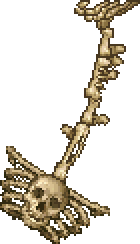
Hanged skeletons,
like skeledragons and white dragons, have been grown spine-first into solid
structures. From their respective perches, they swing back and forth to act
as either obstacles or uncooperative platforms. There are two known species:
Hanged bones, which while they swing periodically spew deadly flames, and
the more tame skeleton trees, which are tougher but more peaceful.
These
skeletons tie together
dislodged bones to form their own version of the Belmont boomerang. When they
thrown onto the ground, they crossed bones begin rebounding about the room
endlessly until destroyed. While you deal with one such projectile, Jack will
begin tossing out more to keep you ever-busy. Stronger versions can throw
speedier, bouncier bones.
|
|
Alternate
Names/Forms: Bone
Thrower & Throw Master |
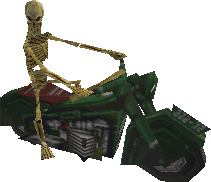
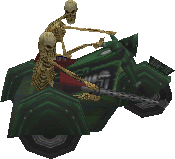
Skeletons
have even learned to operate mopeds. This particular set of skeletons ride
along and try to swipe at you with their clubs. They're pretty fast, too,
but they can't turn that quickly. However, some of them have their buddies
riding along in sidecars, and these extra-annoying fiends fire away with
machine guns while they chase you down. After killing the skeleton, the
bike will crash and burn--so get out of the way
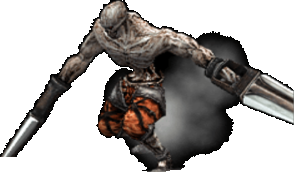
These are the skeletons of
otherwise enormous human beings; they carry around their equally gigantic
bones. A paranthropus has a predictable pattern of attack: (1) It chucks a
bone forward in an arc. (2) It gathers itself and uses said bone for an overhead
swipe, therein crashing it into the ground. And (3) it dives into the air
in, an attempt to land on your head, and upon landing slides along the ground.
|
|
Alternate Names/Forms:
Big Skeleton |
If
you're going to enlist skeletons, former athletes may be the best way to go.
These skeletons retain the athletic ability as showcased in their living days,
and they'll use these superior attributes to dazzle you with a show of pure
speed. Without warning, that is, they'll quickly
dash in your direction.
The supreme athlete is a skeleton medalist, a taunting foe that quickly speeds
away on sight.
This rare member of skeleton
family rests behind a bar and reacts to its "customers" by sliding
along the bar's surface special drinks straight from the tap. The bad news
is that heroes may not like the concoctions, which are laced with liquids
that cause damage plus poison, curse and other troubling states.
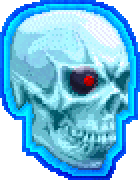
These are the skulls of the
unfortunate Transylvanians (those of whom you can often see piled together
in certain areas of the castle) that fell victim to a guillotine. Even without
bodies, the decapitated menaces stalk the living by floating through the air
in patterns designed to make you think and attack quickly.
|
|
Alternate Names/Forms:
Phantom Skull & Flying Skull |
These monstrosities are much
larger than their skull head counterparts, their plight more troubling: Phantom
skulls are executed soldiers that now seek eternal revenge. Skull Lords take
to this mission by following you around and use their size as both the means
for offense and to create large obstacles. Maybe they're just ticked about
having gone through life with a huge heads?
|
|
Alternate Names/Forms:
Large Ghost, Giant Ghost & Great Ghost |
This
particular type of skeleton throws forward
in succession up to three
rib bones, each capable of inflicting repeated damage. Their shields are useless,
despite such prominence, offering none in the way of protection. If you simply
duck under the bones, a slinger's efforts will be for naught. They're most
effective when paired with regular skeletons, which complement this attack
with their arcing bones.
|
|
Alternate
Names/Forms: Skeleton
Rib |
It's just your average dislodged
skull head with attached spine--a more persistent phantom skull, I'd say.
These are more of a threat, though, because there's more mass to them than
just the skull; this will be evident if a group of such surrounds you and
begins circling. It doesn't help that spines attack at an endless rate.
These are petrified
skull heads that bob up and down, spinning in place all the while. Stone skulls
have no attacks, their sole purpose to act as obstacles within narrow passages
and other difficult areas; stone skulls are invincible, too--all attacks nullified
or deflected. There are two forms of stone skull--normal
and minotaur-bull--which despite their
unique appearances function the same.
II:
Armed Skeletons
Armed skeletons have been
equipped with certain types of armor that make them tougher to destroy. More
importantly, they command deadly weaponry for a greater threat; some have
mastered a given weapon to the point where they have increased ability.
The fearsome,
skilled armored skeletons hold a special place in Dracula's ranks. Most cruelly,
it's said that the same spell that keeps them animate also fills them with
the false hope that they can continue serving the cause for which they trained
while they were amongst the living. The highly defensive armored skeletons
attack with vicious axe-swipes, and they can also execute mad dashes using
their shields as both a cover and blunt instrument.
These are skeletons trained
in advanced combat, especially with twin-bladed swords. They employ a surprise
attack that involves slide kicks and acrobatic leaps leading to jump kicks
and down-thrusts; they'll soon
after catch you off guard with dashing
and flying stab attacks. The stronger versions are more defensive-minded and
prefer to attack only when an opening presents itself.
|
|
Alternate Names/Forms:
Skeleton Blaze & Blaze Master |
Here was have
s ingle-blade soldiers that use stealth and long-reaching lunges to attack
off-balance, unprepared heroes. Twin-bladed soldiers are less-disciplined
versions of the Blade Masters and lack acrobatic prowess; they attack in either
of two ways: They quickly jut forward, swords extended, or they lunge in the
hero's direction with a down-thrust. Advanced twin-bladed soldiers can press
the blades together, channel energy between them, and then release an effective
spell (a slow-moving projectile).
|
|
Alternate
Names/Forms: Skeleton
Hero |
These slithery
skeletons are armed with bows and and quivers housing endless amounts of arrows.
Bone archers are often well-postioned in inconvenient locations, where they
remain stationary; others prefer to prance around and stalk their target.
When you're within range, they'll fire arrows both high and low, stopping
only to refresh their supply.
|
|
Alternate
Names/Forms: Skull
Archer & Skeleton Archer |
These skeleton are trained
in the use of a naginate spear. All such attacks involve swinging the spears
wildly and at great range, which will be a problem in that this enemy type
patrols narrow halls and passages. As such, it's difficult to get in close
enough to initiate your own offense, to which a halberd will react quickly.
|
|
Alternate
Names/Forms: Skeleton
Spear |
This is the first
form of skeleton in Dracula's army to be equipped with a rifle. There's nothing
to fear in terms of a musket's mobility, since this enemy type is typically
married to its starting position; more dire is its speed in firing the weapon,
which happens with little in the way of warning, with a very quick reload,
and with dramatic damage to an ill-prepared warrior. They're at their most
dangerous when lurking amongst other bone muskets or when paired with hordes
of other lesser enemies.
|
|
Alternate Names/Forms:
Skeleton Gunman |
These are described as "ferocious skeleton warriors
equipped with a sword." A scimitar will always try to catch you off balance
by remaining at a distance relative to your own. When you draw near, they'll
surprise you with a quick sword-swipe; due to lack of speed and mobility,
scimitars leave themselves open to counterattack if they miss. The Simon's
Quest versions are the only out-of-the-ordinary form, since some of them
can jump and throw bones.
|
|
Alternate Names/Forms:
Skeleton Soldier, Skeleton Knight, Dead Crusader,
Bone Soldier, Skeleton Mirror, Spartacus, Skeleton Fighter & Skeleton
Warrior |
Skeletons of
this type lie in wait with clubs in bony hand, and they're very much intent
on holding their ground, which is why they remain mostly stationary. When
you get close to them, they reel back their clubs and subsequently attempt
to smash you over the head with them.
Dhurons were
beheaded during their living days, whence they sailed the seas as pirates;
now undead, they carry around
their own heads as emblems of their
exploits. The skulls aren't for show, as they somehow retain working ocular
functions. Dhurons are cagey fighters whose offense consists of sudden rapier
stabs. More advanced forms, if perturbed, will raise their swords into the
air and conduct into them lightning, after which they'll fire bolts out from
the rapiers' tips.
|
|
Alternate
Names/Forms: Dullahan |
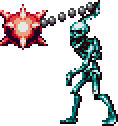
This is a moderately
armored skeleton equipped with a mace-adorned staff (flail). When you get
too close for its liking, it'll stand upright, hold the flail overhead, creep
back to create space, and then viciously swing its weapons; it follows up
this attack by for a few seconds dangling the spiked ball, a purely defensive
measure. Though tougher to figure than normal skeletons, they're especially
frail when compared to the rest.
|
|
Alternate
Names/Forms: Skeleton
Flail |
Flame skeletons are best
described as a fiery variety of skeleton warrior. These enflamed undead
beings rise up from the ground with deadly clubs in hand; they attack with
single- and multi-step club-swipes plus a long-reaching dash. The highly
defensive flame skeletons carry sturdy shields, which must be destroyed
if you hope to inflict any real damage on them.
Due to the sheer bulk of their spikey weapon,
skeletons armed with maces are forced to remain stationary. When you near
a mace skeleton, it'll swing around the weapon overhead three times, each
rotation stretching outward progressively farther than the last. Upon the
attack's completion, it'll pull back the mace and rest for a short period.
These skilled skeletons stand
arms crossed, leaning against the wall and coolly waiting for intruders to
come near. When they sense a foe nearby, they'll spring into attack position
and throw two large boomerangs over a long distance, each traveling at opposite
range but upon return
eventually crisscrossing. Many skelerangs
placed in proximity can result in a hero trapped within a storm of twisting
wood. A skelerang's brevity comes in short supply, however, as crowding one
into a corner will cause it to cower in fear.
|
|
Alternate Names/Forms:
Skeleton Boomerang |
Armed
skeletons are bad. Giant skeletons are worse. Giant armed skeletons? They're
just beasts--slow-moving brutes that carry with them ridiculously oversized
weapons. The standard Skeleton Beast carries a giant club, which it slams
into the ground with little warning; if a foe gets too close, it'll strike
with a low kick. The superior King Skeleton carries a giant axe and wields
it in much the same way; its alternate attack is more physical in nature,
as it'll reach down, snatch heroes, deliver a flurry of punches, and then
violently toss away the battered victim.
The
skeleton blaze group consists of ninja-like skeletons who confuse opponents
with swift movements and then rush in to kill them with swipes of their razor-clawed
arm attachments. There exists two advanced classes: The superior blaze masters,
who throw exploding knives, and the elite blaze phantoms, who use their impressive
speed to avoid taking damage when attacked.
|
|
Alternate Names/Forms:
Blaze Master & Blaze Phantom |
These
shadowy skeletons are armed with battle gear, a protective shield and other
special equipment. Guardians will slowly trek forward with their shields
held outward to block most straightforward attacks (in riot-control fashion).
They'll only let their guard down after accosting an enemy and swinging
the spear overhead; otherwise, the guardians will point forwardtheir
spears and come at you with a surprise dash.
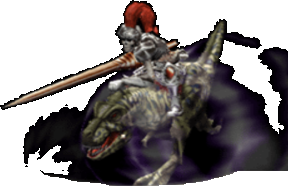
These
armored skeletons attempt to overpower foes from atop their dragon steeds.
Mainly, they charge toward their targets with their lances. The advanced
skeleton troopers instead mount heavily armored dragons, whose weight causes
little loss of mobility. Really, each represents a team threat, since
their mounts will continue to attack even after their skeleton riders have
been felled.
|
|
Alternate
Names/Forms: Skeleton
Trooper |
Skeletons armed with spears
stay grounded and create a considerable obstacle by erratically stabbing forward
their spears. As you would when dealing with scimitars, you'll want to stay
at a distance and attack when an opening presents itself. The most dangerous
form of spear skeleton is the class that rides on logs and chases you via
the sea and its tides; if you slip up even once when encountering one, a skeleton
spear will hastily send you to a watery grave.
|
|
Alternate Names/Forms:
Spear Skeleton |
Though they've
since been slain, these former warriors still believe it their mission to
protect the castle from intruders. Loyal only to their new Dark Lord, they
ceaselessly guard his fortress, never leaving their post. These remnants assail
with quick sword swipes and use their weapon to defend against attacks. They
can in addition toss enflamed axes in arcs. The advanced, helmeted form executes
standing and dashing swipes, and it can spin with such force that it'll for
a limited time become a "living" tornado and attempt to crash into
its enemy.
|
|
Alternate Names/Forms:
Thunder Warrior, Flame Warrior & Ice Warrior |
Undead
lords are a class of highly trained combat skeletons. They're top-ranking
in that regard, the lords blessed with great intelligence and attack power.
They attempt to pummel their opponents with lightning-quick mace strikes.
| . |
Whip-Toting
Skeletons
|
. |
The more tricky
skeletons are armed with whips--perhaps as a little psychological ploy. Because
the whips aren't weighty, the skeletons are able to retain their high-jumping
ability, able to swing the whip at any time and from any position at long
range. Advanced whip skeletons stay grounded and instead rely on pure speed
and an ability to brandish their whips.
|
|
Alternate Names/Forms:
Simon Wraith |
A skeleton wight's pattern
of attack can best be described as "lazy," which may be the perfect
setup. Wights slowly tread over a platform until they sense a hero, wherein
they slash their swords in what will seem like a mistimed reaction; to the
contrary, you'll immediately find that this has a fiery and lengthy result.
In order to defeat the tough wights, you must prevent their attacks and continue
to knock them back, off balance, until they eventually keel over.
Page 2 | Back