 |
||||||||||||||||||||||||||||||
|
|
|
|
||||||||||||||||||||||||||||
 |
||||||||||||||||||||||||||||||
|
Alternate
Incarnations
|
 |
| Super
Famicom Release Date: October 31st, 1991 - A retelling of Simon Belmont's original adventure, the Japanese version, too, is simply titled Akumajou Dracula, which translates to Demon Castle Dracula. Europe Release Date: August 27th, 1992 - The European version arrives almost a full year later. |
 |

|
Re-Release
Information
|
|
|
2006: 2013: 2016: 2017: 2019: 2020: 2020: 2021: 2021: 2025: |
|
|
The
Manual's Synopsis
|
|
|
EVIL
LURKS IN THE DARKNESS... Every 100 years Dracula is revived and grows stronger and stronger. His goal is to turn all humanity into creatures of darkness, to be ruled under his iron fist. He has appeared in this world many times, and there are many people who fear that in his next appearances, he may be unstoppable. There is one group that has always been around to see that Dracula is defeated, the Belmont family. For generations the Belmonts have passed along the secrets and skills of vampire-hunting to the eldest child of the family. While many of the Belmonts have lived peaceful lives without encountering Dracula, they remain prepared. There are occasional skirmishes with lesser monsters, but the Belmont clan has always emerged victorious. Now, 100 years have passed since the last battle between Dracula and the Belmonts. Transylvanians are reporting mysterious sightings of odd creatures appearing under cover of the darkness. As Spring approaches, the citizens prepare for a traditional celebration. Unbeknownst to them, an evil group of people is holding a ceremony in the old destroyed abbey outside of town, attempting to revive the Prince of Darkness. As they carry out their ritual a dark cloud descends over the countryside. The sinister group stirs itself into a frenzy of mysterious chanting and pagan dancing, then lightning strikes the abbey. The ground bucks under their feet, and the abbey walls shudder. Once again, Dracula is revived! It is time once again for Simon Belmont to call forth the powers of good to aid him in his battle. Armed with his mystical whip, his courage and the centuries-old knowledge of Belmont family training, he sets forth on his mission... |
|
|
Objective
/ Overview
|
|
|
In the creation of this game--an SNES masterpiece--Konami saw the opportunity to finally supply to its series an overarching storyline, to render a more cohesive feel and a lineage in which to follow. By that token, Super Castlevania IV has the disappointing but very forgivable distinction of being a 16-bit remake of the NES classic Castlevania, a reintroduction, if you will, and not a unique storyline entry. As an alternate rendition of Simon's adventure, though, it's an upgrade in every sense. Super Castlevania IV may be as its name suggests ("super," indeed), but it doesn't abandon the classic formula; it very much remains true to the series' roots while turning up the volume several notches. And while Konami presents a stage-by-stage experience that doesn't attempt to trump Dracula's Curse's conventions of multiple routes and helper allies, it does go the extra mile in supplying a graphical feast, a superbly realized control scheme, an excellent musical score, and a whole world of new ideas that make the difference between remake and retread. You must take control of the sleek Simon Belmont and guide him through eleven stages, each filled with the dangers to which you've become accustomed plus many frightening, screen-bending new scenarios. Therein, your goal is to reach the final stage and destroy the infamous Count Dracula. As in prior titles of the same formula, you can after the credits play through a second time for a more difficult quest. |
|
|
Version
Differences
|
|
|
Japanese Version
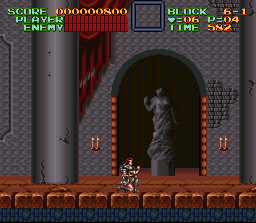
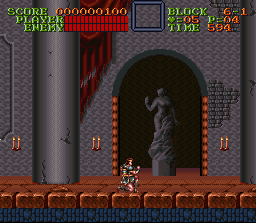
- The statues in the Main Hall are disrobed.
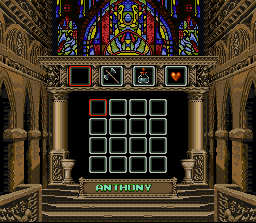
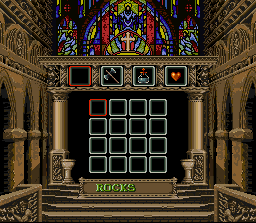
- You can see the likeness of Jesus Christ in the password screen's top portion.
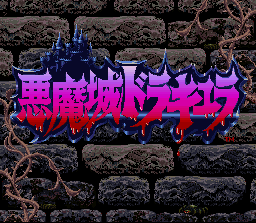
- On the title screen, blood, rather than water, drips from the game's logo.
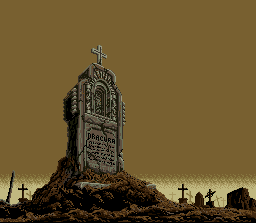
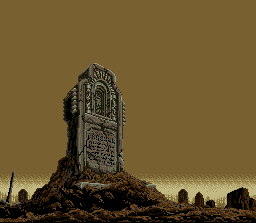
- Dracula's name appears on the intro scene's tombstone. Though, it's the Japenglish form of the name (Dracura).
- The graveyard stages' tombstones also bear crucifixes.
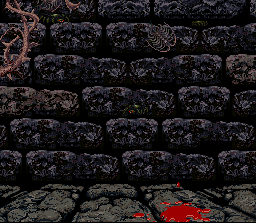
- The dungeon stage contains
blood-filled pools rather than slime-filled marsh pits. In this scenario,
blood, rather than slime, drips from the dungeon's ceiling.
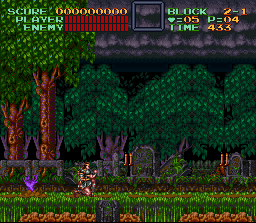
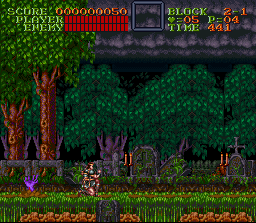
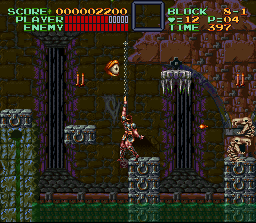
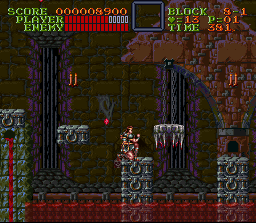
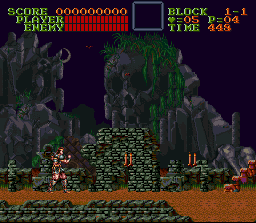
- The font used in the game's HUD is different. It's more gothic in flavor, and it's colored with darker varities of green and orange (as illustrated in the following screenshot.)
- The sound effect for whip-snaps is different. It's the same sound that's made when you toss a dagger. (Thanks to Danny, Sam and Anthony for this information.) Prototype
Version Differences |
|
|
Soundtrack
and Credits
|
|
|
Soundtrack
Links |
|
|
Character
List
|
|
|
Lesser Enemies
Bosses
Dracula Forms
|
|