
Date Released
Developed By
Published By
September, 1990
Konami
Konami
Playable Heroes
Stage Number
Game Size
Trevor Belmont, Grant Danasty, Sypha Belnades, and Alucard
16 Stages (60 blocks)
512KB
Original Platform
Nintendo Entertainment System (NES) 
Platforms Ported To


PC (Castlevania and Contra: Konami Collector's Series) | Cell Phones | GameTap | Wii (Virtual Console) | 3DS (Virtual Console) | Wii U (Virtual Console) | PS4 (Castlevania Anniversary Collection) | Xbox One (Castlevania Anniversary Collection) | Nintendo Switch (Castlevania Anniversary Collection) | Steam (Castlevania Anniversary Collection) | PS5 (Castlevania Anniversary Collection)


    Alternate Incarnations
  Famicom
Release Date: December 22nd, 1989
- The Japanese version is titled Akumajou Densetsu,
which translates to Legend of Demon Castle.

Europe
Release Date: December 10th, 1992
- The European version as usual arrives much later than its North American and Japanese counterparts.
 

    Re-Release Information
 

2002:
   PC CD-ROM
   Developed By: Konami
   Release Date:
November 16th

It's r e-released as part of Konami Collector's Series: Castlevania and Contra for the PC CD-ROM.

2006:
   Cell Phones
   Developed By: Konami
   Release Date: Japan - (Month Unknown)

It's re-released in Japan, under its Japanese name, for play on cell phones.
   GameTap
   Developed By: Konami
   Release Date:
(Month Unknown)

The originally-PC-only Konami Collector's Series: Castlevania and Contra was ported to GameTap, the multi-system game-download service, with included an individual re-release of Castlevania III: Dracula's Curse
. It was removed from the service as of September of 2010.

2008:
   Wii (Virtual Console)
   Developed By: Konami
   Release Date:
Europe - November 16th

In Europe, Dracula's Curse becomes digitally downloadable on Wii's Virtual Console via its Shop Channel. It became unavailable when the service shut down on January 30, 2019.

2009:
   Wii (Virtual Console)
   Developed By: Konami

   Release Date: North America - January 9th | Japan - April 21st
Dracula's Curse arrives on the Virtual Console in North America and Japan. It became unavailable when the service shut down on January 30, 2019.

2014:
   Wii U (Virtual Console)
   Developed By: Konami

   Release Date: Japan - April 16th | North America - June 25th | PAL Territories - September 4th
Dracula's Curse makes its second Virtual Console appearance, this time for the Wii U. North America, Europe and Australia had to wait a few additional months for no particular reason.
   3DS (Virtual Console)
   Developed By: Konami

   Release Date: PAL Territories - April 17th | North America - June 25th
Curiously, Nintendo of Europe decides to release the 3DS version in proximity to the Japanese Wii U release, showing a clear lack of synergy. The North American version arrives the same day as the Wii U release, continuing the scattered release-schedule.

2019:
   PS4, Xbox One, Nintendo Switch and Steam (Castlevania Anniversary Collection)
   Developed By: M2 | Published By: Konami
   Release Date:
All Territories - May 16th (note that the Steam version only saw a North American release)
Castlevania III: Dracula's Curse appears in this collection as one of eight classic series titles.

2021:
   PS4 and Nintendo Switch (Castlevania Anniversary Collection)
   Developed By: M2 | Published By: Limited Run Games
   Release Date: TBA
Publisher Limited Run Games releases four separate physical versions of the Castlevania Anniversary Collection for the PlayStation 4
(it's also playable on the PlayStation 5) and the Nintendo Switch. Check the Castlevania Anniversary Collection page for more information.


    The Manual's Synopsis
     IT'S A CURSED WORLD WE LIVE IN
                                   (THANKS TO DRAC!)
The time is 100 years before Simon Belmont's birth. The moon burns red overhead and black clouds loom large on the horizon. All is still and quiet. Only the call of a distant crow stirs the cold night air. Suddenly, thunder roars out of the Morbid Mountains and into the village of Warakiya. Like the yell of an angry giant, the terrible sound shakes homes and shops as if they were sapling branches.
       But no one blinks an eye. The village is dead calm. For all the people have fled after receiving warnings from the Great Beyond that Count Dracula has assembled a mighty army of evil, and they're poised to march up from the Valley of Graveyards to bury mankind in a Tomb of Terror. Unfortunately, there's no corner on Earth that won't be gobbled up by this bloodthirsty legion of Swamp Dragons, Slasher Skeletons and Forces of the Undead.
       The last line of defense is you, Trevor Belmont--the forefather of Simon Belmont and the origin of the Belmont Warlord Chromosomes. But your chances are slimmer than Jim. In fact, the only real edge you have over this fang sharpened freak is your power to transform into three different partner spirits: Grant DaNasty, the ferocious Ghost Pirate. Sypha, the Mystic Warlord. And Alucard, Dracula's forgotten son. Each of these spirits will confront you as you fight through 17 possible levels of never-ending fright, including the Haunted Ship of Fools, the Clock Tower or Untimely Death and Curse Castle. You must also possess the strength to wield the might Battle Axe and Mystic Whip, which were given to you by the Poltergeist King.
       So go forth young Trevor into the cold black knight, where death lurks around every corner and evil lingers on every stone. And remember, if your courage and cunning are any less than magnificent or if you fail to choose the correct Paths of Fate, you'll be banished to the world of the undead, and zombies will rule until the end of time.
 

   Objective / Overview
 

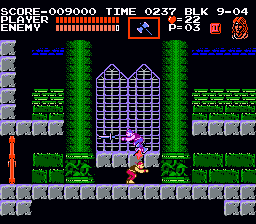
Konami in Castlevania III: Dracula's Curse ushers the return of the series' classic formula after its short vacation in deference to Simon's Quest's adventure-RPG escapades. That is, we're again presented the tried-and-tested style of stage-by-stage action. Though, Dracula's Curse is anything but content and complacent, and the objective's description is hardly fitting: You must take take control of Trevor Belmont and guide him through a number of stages--each crammed with enemies, loaded with traps, and resided over by boss guardians--to infiltrate the ancient Castlevania, to arrive at the castle keep, and to destroy the confident Count Dracula.

The game's greatness is defined by how you accomplish this task: Available to Trevor are four possible routes, each with an unassigned but noticeable difficulty level, that take him across the countryside and eventually through Castlevania. On any path, you can meet up with at least one ally that has been assigned to it, a system that offers multiple replayability combinations in terms of paths and allies; though, you can only have one ally at a given time.

Once you clear the game, you can partake in a second, tougher quest with the assistance of the ally, if any, with whom you defeated Dracula (though, you can't swap allies the second time through). It's in this harder quest where you'll run across some enemies you hadn't seen the first time around.


   Version Differences
 

Japanese Version
There are a huge amount of differences in the Japanese version:
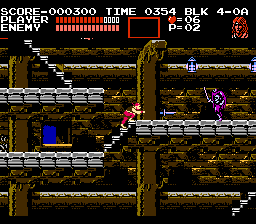
- Some of the main characters have slight deviations on their names. Strangely, Trevor's name is "Ralph Belmondo" (in the manual mainly, as the "o" is missing here).

- The clouds seen over Dracula's castle in the intro sequence are more numerous and feature an animation which sees them drift off to the left.
- The zombie sprites are different--a bit drunkard-looking--as are those for the mad frogs and the mummy men; also, the mud men are more-animated. The boss leviathan boss also sports a slightly different look.
- Hunchbacks are replaced by gremlins (the type you've seen in Super Castlevania IV).
- After agreeing to Grant Danasty's request, Trevor uses his right hand to shake Grant's left hand, which makes for a weird visual.
- Rather than using a stabbing dagger, Grant wields throwing-daggers as his normal weapon.

- Because his main weapon is already a throwing dagger, Grant can only collect the axe and stopwatch sub-weapons.
- Heroes suffer varying amounts of damage depending upon the enemy type.
- The music is of much higher quality because the cartridge includes Konami's custom VRC6 chip, which supports three extra sound channels and produces better digital sound.
- The sound effects are also higher in quality, theirs a richer, more reverberant conveyance.
- The ally-switch sound effect is different--more cosmic-sounding.
- There are timing differences in some of the enemies' patterns and attacks. The leviathan, for instance, moves more quickly and spews two smaller fireballs. The cyclops and Dracula's first form, too, move about in notably different ways.
- T
here's some different item-placement for candleabras and breakable bricks.
- There's also some different enemy-placement. In comparison to the North American version, there are scenarios where enemies are missing (including those that endlessly spawn and fly in from offscreen), moved around, or appearing in greater number.
- There are a lot of palette differences in regard to background imagery and some enemies; most notable is the green phantom bat. Also, there are times when textures feature significantly less detail.
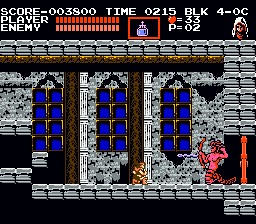
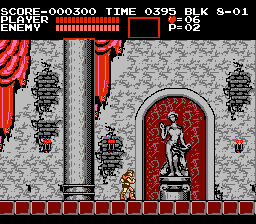
- Medusa has female characteristics (as seen in the second image).


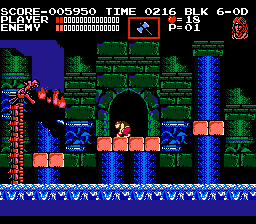
- Water dragons breathe slower-traveling, shorter-range flame-blasts. Also, they can breathe flames diagonally downward. They hold their flame attacks longer no matter the direction they're being spewed.

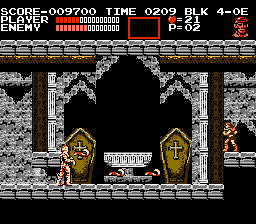
- The boss mummies throw shards high and low rather than in a wavy pattern.


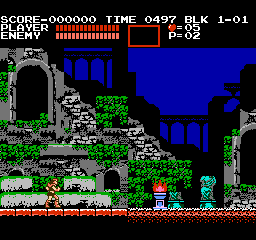
- There are some minor structural differences (i.e. missing blocks), like the one seen in the bottom-right portion of the screenshot above. There's also a missing layer of blocks in the Stage 15 boss room under which Grant can camp and safely pick off the Doppelganger if he's in possession of an axe sub-weapon.
- There are no skull heads, armed knights or robed zombies in the second quest (or in the game, period).
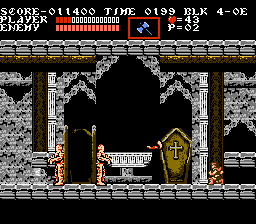
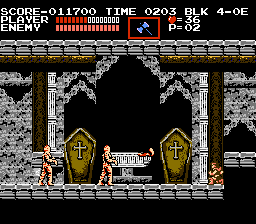
- After boss creatures emerge from their tombs, the coffins' lids remain closed, the expected coffin-opening animation clearly missing.


- Skeledragons and the Bone Dragon King can be damaged by weapon contact anywhere rather than just their heads.
- The Bone Dragon King goes into the second phase of his battle with less health--a mere two bars. Also, he has a unique death animation in which his individual spinal bones fall off and drop down into the water, where they make individual visual splashes.
- Axe Knights' shields can't block the boomerang. The boomerang passes through them and inflicts its usual coming-and-going piercing damage.
- Ucovered triple-shot symbols aren't replaced by big hearts if you're already in possession of a triple-shot; rather, they're recollectable and award points.
- Ghostly eyeballs and bone-throwing skeletons have sound effects attached to their respective attacks.
- Concerning the final Dracula battle: If you die, you restart right near the castle keep stairway rather than back near the pendulums. However, the game returns you to the stage's starting point if you run out of lives and continue.
- Dracula's final form fires shorter lasers.
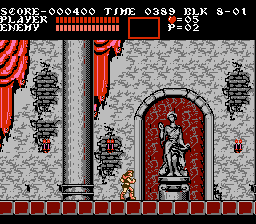
- Statues are disrobed and religious symbols, like crucifixes, are visible, where in the North American version they're covered/removed.


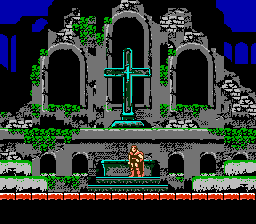
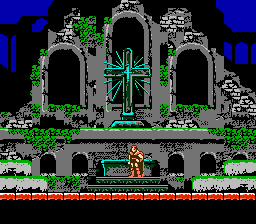
- Most noticeably, the crucifix in the intro bears rays that suggest that power is emanating from the object. They were removed from the North American version due to Nintendo of America's strict policy in regard to overt religious themes.


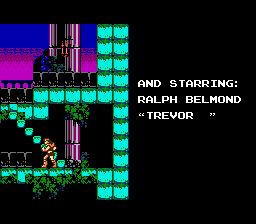
- The text, as seen atop the screenshot below, is presented in a normal font rather than the gothic font used in the North American version.

- The second-quest and starting-ally passwords do not work in this version.
- This version is generally easier than its western counterpart: Enemy projectiles travel slower. Trevor is able to more quickly power up the whip. And tougher-skinned minor enemies die in fewer hits.

European Version
There are some minor European differences:
- This release is less difficult than its North American and Japanese counterparts due to a single change: The heroes take one less bar of damage than they do in the other versions. For example: Trevor loses only one bar of health when damaged by enemies on the first stage.
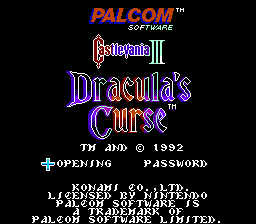
- The game was in part published by "Palcom Software," a Konami subsidiary that used to handle PAL conversions; this is noted on the game's title screen.

- As in the North American version compared to the Japanese version, the rays have been removed from the cross in the intro.


- The stopwatch's duration seems to last longer than expected--an extra second than is usual. (Thanks to Danny, Enrico De Castro, Carl, B. Busta, and Amar Youkai for some of this information.)


   Soundtrack and Credits
 

Soundtrack

1. Prelude 11. Anxiety 21. Overture
2. Epitaph 12. Rising 22. Big Battle
3. Prayer 13. Dead Beat 23. Final Battle
4. Beginning 14. Stream 24. All Clear
5. Boss Battle 15. Nightmare 25. Evergreen
6. Stage Clear 16. Aquarius 26. Flash Back
7. Destiny 17. Demon Seed 27. Player Miss
8. Clockwork 18. Déjà vu 28. Game Over
9. Encounter 19. Riddle  
10. Mad Forest 20. Pressure  

Links
Music Files: MP3 (American and Japanese) and MIDI
Soundtrack Release: Dracula Perfect Selection, Akumajou Dracula Best,
Dracula Battle Perfect Selection, Akumajou Dracula MIDI Collection and Castlevania Best Music Collections Box
Game Credits:
Available


   Character List
 

Lesser Enemies

Skeleton Zombie Vampire Bat
Fishman Knight Medusa Head
Hunchback Skeledragon Red Skeleton
Ghost Harpy Raven
Pillar of Bones Axe Knight Winged Guard
Slime Spider Ghostly Eyeball
Fire Man Mud Man Mummy Man
Skullgead Whip-Toting Skeleton Balloon Pod
Whip-Toting Red Skeleton Bone Scimitar Mad Frog
Owl Dhuron Ball of Destruction
Armed Knight Robed Zombie

Japanese-Version Exclusive Lesser Enemies

Gremlin

Bosses

Skull Knight Nasty Grant Cyclops
Medusa The Mummies Phantom Bat
Alucard Frankenstein Water Dragons
Skull Knight King Bone Dragon King Leviathan
The Grim Reaper Doppelganger

Dracula Forms

Dracula Dracula's Ghost I Dracula's Ghost II

Supporting Cast

The Poltergeist King