Date Released
Developed By
Published By
May, 1987
Konami
Konami
Playable Hero
Stage Number
Game Size
Simon Belmont
6 Stages (18 blocks)
128KB
Original Platform
Nintendo Entertainment System (NES)
Platforms Ported To


Commodore 64 | IBM PC | Amiga Home Computer | Arcade | PC (Castlevania and Contra: Konami Collector's Series) | Cell Phones | GBA | GameTap | Wii (Virtual Console) | 3DS (Virtual Console) | Wii U (Virtual Console) | NES Classic Edition | PS4 (Castlevania Anniversary Collection / Arcade Archives) | Xbox One (Castlevania Anniversary Collection) | Nintendo Switch (Castlevania Anniversary Collection / Arcade Archives) | Steam (Castlevania Anniversary Collection) | PS5 (Castlevania Anniversary Collection)


    Alternate Incarnations
  Famicom Disk System
Release Date: September 26th, 1986
- In Japan, on the country's NES equivalent, the game's original title is
Akumajou Dracula, which translates to Demon Castle Dracula.

VS. Castlevania
Release Date: 1987 (Month Unknown)
- Its first arcade incarnation is part of Nintendo's Versus series. As such, its title is VS. Castlevania.
The arcade machine was published by Nintendo.

Playchoice-10
Release Date: 1987
(Month Unknown)
- Castlevania appears as one of ten available titles in Nintendo's Playchoice-10 arcade cabinets.
The arcade machine was published by Nintendo.

Europe
Release Date: December 19th, 1988
- Its European release is in late December.


Famicom
Release Date: February 5th, 1993
- The more traditional game-pak release was also titled
Akumajou Dracula, which translates to Demon Castle Dracula
.
 

    Re-Release Information
 

1990:
   Commodore 64
   Developed By: Unlimited Software Inc. | Published By: Konami
   Release Date: North America - (Month Unknown) | Europe - (Month Unknown)
Developer Unlimited Software's is a somewhat-faithful conversion of Konami's classic. It's one of three home-computer versions released during this time-period. To learn more about its availability, please
click here.

   Amiga Home Computer
   Developed By: Novotrade
| Published By: Konami
   Release Date: North America - (Month Unknown)
Novotrade's uniquely crafted conversion of Castlevania hits the market around the same time as its home-computer counterparts.
To learn more about its availability, please click here.

   IBM PC
   Developed By: Unlimited Software | Published By: Konami
   Release Date: North America - (Month Unknown)
This DOS-based conversion rounds out the trio of home-computer versions of Castlevania.
To learn more about its availability, please click here.


1993:
   Famicom Disk System
   Developed By: Konami
   Release Date:
February 5th
It's re-released in Japan, ported from the Disk System to the regular Famicom.

2002:
   Cell Phones
   Developed By: Konami
   Release Date:
(Month Unknown)
Re-released in Japan, under its Japanese name, for play on cell phones
.
   PC CD-ROM (Konami Collector's Series: Castlevania and Contra)
   Developed By: Konami
   Release Date:
November 16th

Re-released in North America as part of Konami Collector's Series: Castlevania and Contra for the PC.

2003:
   Cell Phones
   Developed By: Konami
   Release Date:
(Month Unknown)
An upgraded version of its previous Japanese cell phone game is released.

2004:
   Cell Phones
   Developed By: Konami
   Release Date:
(Month Unknown)
Yet another upgrade to its Japanese cell phone game
is released.
   Cell Phones
   Developed By: Konami
   Release Date:
(Month Unknown)
A
cell phone version arrives for play in Europe, and it emulates the Japanese second iteration.
   Cell Phones
   Developed By: Upstart Games
   Release Date: July 7th
Re-released in the U.S. for play on cell phones. Like its European counterpart, it emulates the Japanese second iteration.

   
Game Boy Advance
   Developed By: Konami | Published By: Nintendo
   Release Date:
August 10th

Re-released in Japan as Vol. 29 of the "Famicom Mini" series for the Game Boy Advance.
   Game Boy Advance
   Developed By: Konami | Published By: Nintendo
   Release Date:
October 25th

Re-released in North America as part of the "Classic NES" series for the Game Boy Advance. The actual title is Classic NES: Castlevania.

2005:
   Game Boy Advance
   Developed By: Konami | Published By: Nintendo
   Release Date:
January 7th
This is the European version of the "Classic NES" series. Its full title is
Classic NES 12: Castlevania
.


2006:
   GameTap
   Developed By: Konami
   Release Date:
(Month Unknown)

The originally-PC-only Konami Collector's Series: Castlevania and Contra was ported to GameTap, the multi-system game-download service, with included an individual re-release of Castlevania. It was removed from the service as of September of 2010.

2007:
   Wii (Virtual Console)
   Developed By: Konami
   Release Date:
PAL Territories - March 23rd | North America - April 30th | Japan - July 17th

Castlevania becomes digitally downloadable on Wii's Virtual Console via its Shop Channel. It became unavailable when the service shut down on January 30, 2019.

2012:
   3DS (Virtual Console)
   Developed By: Konami
   Release Date: Japan - October 19th
After taking a five-year break from its port binge, Akumajou Dracula returns to action on the 3DS via its Virtual Console section on the eShop.

2013:
   3DS (Virtual Console)
   Developed By: Konami
   Release Date: PAL Territories - February 14th | North America - April 4th
The PAL and North American 3DS Virtual Console releases of Castlevania arrive on the 3DS eShop months after the Japanese release.
   Wii U (Virtual Console)
   Developed By: Konami
   Release Date: Japan - December 4th | North America - December 19th
The original Castlevania becomes the series' first entry to complete the trifecta, appearing on all three versions of Nintendo's Virtual Console.
This version features both Miiverse integration and off-screen play.

2014:
   Wii U (Virtual Console)
   Developed By: Konami
   Release Date: PAL Territories - March 20th
Due to a continuing lack of synergy between Nintendo's separate international headquarters, Europe had to wait four months for its Virtual Console version of Castlevania.

2016:
   NES Classic Edition / Nintendo Classic Mini: Nintendo Entertainment System / Nintendo Classic Mini: Family Computer
   Game Developed By: Konami | Machine Published By: Nintendo
   Release Date: All Territories - November 11th
Castlevania is one of thirty titles included in Nintendo's miniaturized NES console--a reminiscently designed plug-and-play device that features digital versions of classic NES games.

2019:
   PS4, Xbox One, Nintendo Switch and Steam (Castlevania Anniversary Collection)
   Developed By: M2 | Published By: Konami
   Release Date: All Territories - May 16th (note that the Steam version only saw a North American release)
Castlevania appears in this collection as one of eight classic series titles.

   Nintendo Switch
   Developed By: Konami | Published By: Hamster
   Switch Release Date: All Territories - October 17th
Hamster brings VS. Castlevania--the arcade port of the original Castlevania--to the Nintendo Switch as an "Archive Archives" title.
   PlayStation 4
   Developed By: Konami | Published By: Hamster
   Switch Release Date: North America - October 17th | Japan - October 17th | PAL Territories - October 21st
Hamster brings VS. Castlevania--the arcade port of the original Castlevania--to the PlayStation 4 as an "Archive Archives" title.

2021:
   PS4 and Nintendo Switch (Castlevania Anniversary Collection)
   Developed By: M2 | Published By: Limited Run Games
   Release Date: TBA
Publisher Limited Run Games releases four separate physical versions of the Castlevania Anniversary Collection for the PlayStation 4 (it's also playable on the PlayStation 5) and the Nintendo Switch. Check the Castlevania Anniversary Collection page for more information.


    The Manual's Synopsis
                                                              GOOD EEEEVENING
       Step into the shadows of the deadliest dwelling on earth. You've arrived at Castlevania, and you're here on business:
       To destroy forever the Curse of the Evil Count.
       Unfortunately, everybody's home this evening. Bats, ghosts, every kind of creature you can imagine. You'll find 'em all over the place, if they don't find you first.
       Because you've got to get through six monstrous floors before you even meet up with the Master of the House. Your Magic Whip will help, and you'll probably find a weapons or two along the way.
       But once you make it to the tower, you can count on a Duel to the Death. The Count has waited 100 years for a rematch. He's ready. Are you?
 

   Objective / Overview
 

Castlevania was the first series' title available to the western world, and, in retrospect, it still reigns as one of the supreme efforts of its time. Its origin is directly correlated to Vampire Killer, the Konami-made adventure for the MSX2 Home Computer. There are many arguments as to which came first in Japan--Vampire Killer or Akumajou Dracula--but it's of no consequence here because of the one-year gap between western localization.

The objective of the game is for the hero, the whip-toting Simon Belmont, to fight his way through six torturous stages filled with evil monsters and devious traps and resided over by the dreaded boss characters--the last of which is the ultimate evil of this game's universe, the vampire Count Dracula. By clearing the game and waiting through the credits, you you can resume play in a sort-of "second quest," a more difficult mission highlighted by an increased amount of sometimes speedy minor enemies.

The gameplay is similar in mechanics for all of the alternate versions (mainly those played on computers), however watered-down each may be. The difficulty of each is increased due to very poor control schemes, maddening design, and other computer limitations. In the late 80s, the Castlevania showed up in arcades as part of Nintendo's Playhoice-10 series; a future arcade port, VS. Castlevania, featured two-player (taking turns, not co-op) action for the quarter-spending masses. Click on "review" at the bottom of this page for more information.


   Version Differences
 

Japanese Version
Famicom Disk System
Two Japanese versions exist with minor differences:
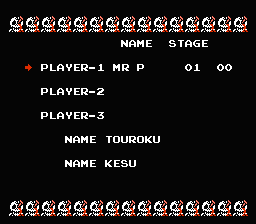
- First, there's the original Akumajou Dracula made for the Famicom Disk System in 1986. This version has a name-entry option (featuring the game's one unique music track) that allows you to save your game into a slot and thus the game's memory (something inexplicably missing from the U.S. version, if you ask me). The name-entry screen features an exclusive music track: Underground, a jingle you might recall from the future Harmony of Dissonance.

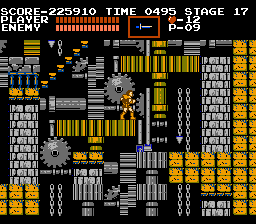
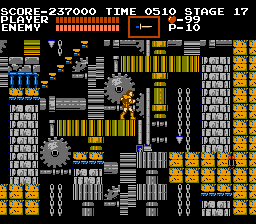
- Also, it features some different layouts in terms of candelabras, as seen in the anomalous scene depicted in the screenshot below, and thus the power-up system controlled therein. For instance: Simon can collect morning-star symbols much earlier than normal, where he usually has to attain five hearts beforehand.


- As this is a disk game, there are loading times--these before and after the transitory map-screen animation, when you arrive at the castle-keep area of the Stage 6, and before and after the ending sequence. Also, if you hope to continue playing past the name-entry screen, you have to flip the disk over when prompted; you have to do so again when you arrive at the castle keep and once more before you can start the second quest.

Famicom
- Then there's the catridge-based version that Konami released years later in 1993. In this version, you can select a "normal" or "easy" difficulty.

- Strangely, when you complete a stage, the heart meter drains more rapidly for only a smaller boost to your point-total
- It has added to its presentation a Konami-logo pre-title screen.
-
In the "Easy" mode, you start with 9 lives and 30 hearts (and start each subsequent stage with 30 hearts). You take way less damage: 1 bar of damage during the first two stages and 2 bars for the final four. There's no knockback. Bosses take more damage and their health meters drain much more rapidly. And you retain your double- or triple shot power-ups when you swap weapons (strangely, this also applies to the stopwatch, which you can use three times in a row in quick succession; though, doing so works to the same effect as using just one, so all you're doing is wasting ten additional hearts).
- As it is in the case of all the Japanese titles, the box cover and manual refer to the hero as "Belmondo" rather than "Belmont."
- The developer cleaned up the stage-clearing glitch that allows you to continue jumping by simply holding down the button; here you have to continuously press the button.
(Thanks to Danny for some of this information.)

Arcade Versions
VS. Castlevania
- This version has a slightly different color-palette, which becomes obvious when certain textures are within view. Zombies, skeletons and skeledragons feature blue shades, for instance, and brown textures are generally brighter. Screenshots showcasing as much are available in the "Alternate-Version Screenshots" portion of the Media section.
- This version features a higher difficulty-level: You're given a lot less time to clear stages. Fewer points are rewarded for enemy deaths. Damage-totals are increased; Simon takes four bars worth of damage in the first two stages, six in the final four, and eight throughout the Second Quest and beyond. And in the Second Quest, repeatedly-spawning bats appear on the very first screen--the entrance's outside portion.


PlayChoice-10
- This one has a more-noticeably-different color-palatte. Texture shades are much lighter, to the point where many of them look washed-out. The saturation level is so low that, for example, blue- and purple-colored textures appear in shades ranging from white to lavender. Reds and browns are also notably lower in intensity.
Screenshots showcasing as much are available in the "Alternate-Version Screenshots" portion of the Media section.


   Port Differences
 

Computer Versions
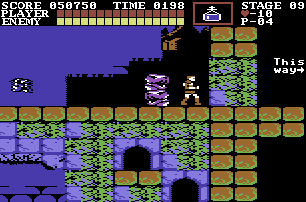
Commodore 64
- This version is clearly inferior in regard to its graphics, music and sound design, but more troublingly it suffers from some very unfortunate mechanical and mechanical issues. You'll find that nothing about its performance is one-to-one.
- Most notably, Simon's movement is completely off: He moves with blistering, almost-uncrontrollable speed, and his jumps carry so much momentum that in some cases he's able to effectively break the level design and access higher-positioned platforms that weren't meant to traversed upon that early. Also, he can inch forward while unleashing series of whip-snaps, which allows him to plow his way forward, however slowly, and generally overcome what's intended to be a built-in limitation; in addition, your whip speed is such that you rapidly take down what are supposed to be super-tough bosses (Frankenstein and the Grim Reaper).
- Being that this is a Commodore 64 game, there's a difference in screen resolution: 300x200 pixels compared to the NES' 256x240. Though, the display wasn't properly adapted; for whatever reason, the graphic designer disproportionately stretched the visuals horizontally and as a result reduced the display by two-and-a-half blocks--
--by four blocks, two on either side. This has the most glaring effect on boss rooms, whose side portions are cut short.
- Enemies' timing, patterns and a.i. differ to varying degrees.
- Enemies aren't stunned by attacks and continue moving forward unabated.
- Enemies respawn if you scroll as much as a single pixel from their original spawning point.
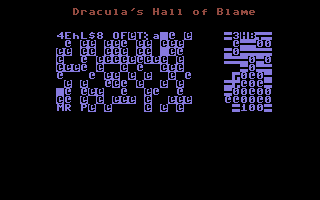
- There's no demo sequence. In its place, we get a credits listing, a cool image of the castle and its graveyard, and then a peek at the high-score screen ("Dracula's Hall of Blame," as it's called here).
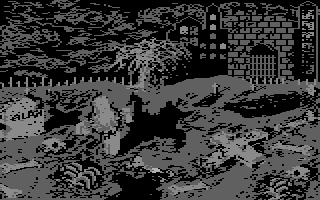
- The game's copy protection requires that you type in certain four-digit codes before you can play it. You can view the codes here.
- You can save your game at any time by pressing Control + S. If you suffer a Game Over, you'll be taken to the high-score screen and thereafter be given the option to "Start Over" or "End." If you choose the former, you'll then be asked if you want to "Start a New Game" or "Continue a Saved Game."
- Commodore 64 controllers feature only one button, so there are two major input alterations: (1) You have to push "Up" to jump. And (2) since "Up" is now assigned exclusively to jumping, you have to hold down the attack button to use your sub-weapon.
- There's no screen transition when you move past a door. Instead, the action simply jumps to the next screen after a short loading time.
- There are prolonged loading times between stages.
- Holy water doesn't freeze enemies.
- There's some differing item-placement for candelabras. Also, Stage 3's second pop-up treasure is moved three blocks inward due to the aforementioned resolution issue.
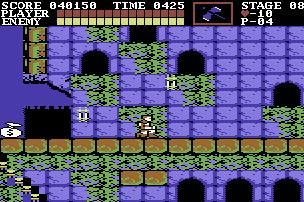
- There's no boss music. Instead the normal stage theme continues to play during battles.
- Due to a memory issue, the battle with the Mummie
s takes place on a separate screen.

- Boss battles don't trigger until you pass the three-quarters point of the screen in question.
- Minor enemies can remain present during boss battles.
- Nothing to Lose doesn't play in Stage 6's final area. Instead you get the Game Over ditty on loop. However, Black Knight does play during the second phase of the Dracula battle.
- There's no Game Over theme. Upon death, instead, the game asks you to flip over the disk and thereafter takes you to the start-or-continue selection screen.
- The ending theme, Voyager, is abbreviated, and sections of it are rearranged in weird ways; this is done to compensate for the music's inexplicably slow tempo.
- The second quest and all subsequent quests have no change in difficulty.

Amiga Home Computer
- This version features a cinematic introduction. A uniquely composed opening theme fades and in and guides us through the title screen and then an exclusive intro sequence wherein lightning strikes and draws attention to the castle as surrounded by forest. Its Simon-sizes-up-the-castle theme is also a unique work.
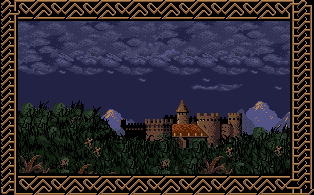
- The game's copy protection requires that you type in certain four-digit codes before you can play it. You can view the codes here.
- The game features key technical and mechanical differences, some beneficial, others detrimental. Simon moves with blazing speed and increased whip range. At full power, the whip covers five blocks--roughly a third of the screen--whereas its NES counterpart covers four; also, it now has a huge hitbox both horizontally and vertically. Otherwise, Simon can jump onto and off of stairs, though awkwardly. This is possible because stairways are treated as sloped platforms.
- The game features a completely new, funky art style that exhibits Novotrade's distinct vision for this "conversion" effort. Also working to express as much are j
azzed-up musical compositions and pronounced sound effects. Most notably, bosses grunt when struck, and Simon screams when he dies.
-
Being that this is an Amiga game, there's a difference in screen resolution: 300x200 pixels compared to the NES' 256x240. Though, the display wasn't properly adapted; for whatever reason, the graphic designer disproportionately stretched the visuals horizontally and as a result reduced the display by two-and-a-half blocks--by four blocks, two on either side. This has the most glaring effect on boss rooms, whose side portions are cut short.
- You can save your game at any time by pressing Control + S. If you suffer a Game Over, you'll be taken to the high-score screen and thereafter be given the option to "Start Over" or "End." If you choose the former, you'll then be asked if you want to "Start a New Game" or "Continue a Saved Game." If you choose to continue, you start in whichever stage area you saved.
- Music tracks aren't correctly paired with stages. Wicked Child plays on Stage 1. Walking on the Edge plays on Stage 2. Heart of Fire plays on Stage 3. Vampire Killer plays on Stage 4. And Stalker plays on Stage 5. However, Out of Time is correctly plays on Stage 6, and it's in fact the only Stage 6 theme; it continues to play even in the stage's final area, bumping out Black Knight.
- This is a one-button game, so you have to push "Up" to jump. And since
"Up" is assigned exclusively to jumping, you have to hold down the attack button to use your sub-weapon.
- The action doesn't pause when you pick up a morning-star symbol.
-
Enemies' timing, patterns and a.i. differ to varying degrees.
- Some enemies take more hits to kill. Knights, for example, now take three.
- There are no doors or door-opening animations. Instead, screen transitions are handled via a quick jump after a short loading time.
-
Boss battles don't trigger until you pass the three-quarters point of the screen in question.
- There's no boss music. Instead the normal stage theme continues to play during battles.
- Enemies' timing, patterns and a.i. Differ to varying degrees.
- Enemies aren't stunned by attacks and continue moving forward unabated.
- The pop-up treasure in Stage 1's fishman area is activated differently; you have to crouch on the lower platform to trigger its appearance.
- Medusa heads home in on Simon rather than wave through the air.
-
There's no 1up pop-up treasure in Stage 5 nor in the game for that matter.
- Certain enemies are missing from their posts. The second bone pillar in block 15, for instance, is notably absent.
- Holy water doesn't freeze enemies.
- There's some differing item-placement for candelabras. Also, Stage 3's second pop-up treasure is moved three blocks inward due to the aforementioned resolution issue.
- There's no death music. Instead the stage theme continues uninterrupted (unless it's your final life).
- When you Game Over, it plays Voyager, which is usually tied to the ending sequence. It continues to play as you're taken to the high-score screen--the "Hall of Blame," as it's called here.
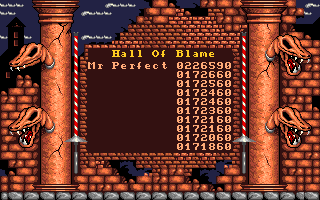
- When Dracula's second form appears, we hear the All Clear music and then silence in following; thus the battle is fought to no musical accompaniment. When you grab the final crystal, it plays the normal stage-clear theme.
- Dracula's second form doesn't spew fireballs.
- The ending sequence consists of the castle being struck by lightning while the Game Over music plays. We're then taken to the high-score screen, where finally Voyager (now correctly, though a bit late) begins to play.
- There's no second quest. After you enter your name on the high-score screen, you're immediately taken back to the game's start-or-continue selection screen.

IBM PC / DOS
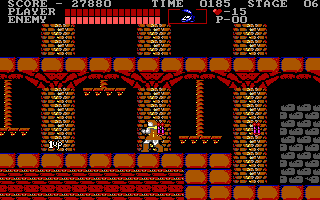
- The DOS version is the closest to the NES version in terms of graphics, technical performance and mechanics, though there are still plenty of marked differences. It's generally faster-paced, and the whip has increased range
. At full power, the whip covers five blocks--roughly a third of the screen--whereas its NES counterpart covers four. And Simon's hitbox is expanded to where he can't jump over enemies who are 32 pixels in height.
- Its audio quality is dependent upon the sound card you're using. There are three such options: PC Speaker, AdLib and Tandy, each producing soundtracks that vary in quality. If you desire to compare them, check the "Soundtrack and Credits" portion of this page and click the appropriate link. Due to audio limitations, the music and sound effects can't play at the same time; rather, the music stops to allow sound effects to blare.
-
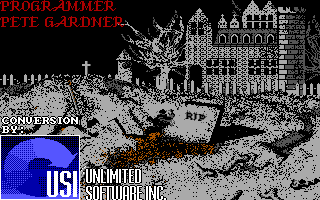
There's no demo sequence. In its place, we get a credits listing with a cool accompanying visual of the castle and its graveyard.
- The action doesn't pause when you pick up a morning-star symbol.
-
Enemies' timing, patterns and a.i. differ to varying degrees.
-
Enemies aren't stunned by attacks and continue moving forward unabated.
-
Being that this is a DOS game, there's a difference in screen resolution: 300x200 pixels compared to the NES' 256x240. Though, the display wasn't properly adapted; for whatever reason, the graphic designer disproportionately stretched the visuals horizontally and as a result reduced the display by two-and-a-half blocks--by four blocks, two on either side. This has the most glaring effect on boss rooms, whose side portions are cut short.
- You can save your game at any time--create a one-time save (virtually a save-state)--and continue from that area of the stage, though with the same health-total and number of lives you had at the time the save was recorded.
-
There's some differing item-placement for candelabras. Also, Stage 3's second pop-up treasure is moved to the other side of the screen, two blocks removed from the trigger point, due to the aforementioned resolution issue.
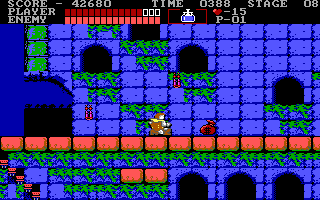
- The pop-up treasure in Stage 1's fishman area is activated differently; you have to crouch on the lower platform to trigger its appearance.
- Boss battles don't trigger until you pass the three-quarters point of the screen in question.
- There's no boss music. Instead the normal stage theme continues to play during battles.
- Holy water doesn't freeze enemies.
- Strangely, some of the second-quest pop-up treasures are present in the first quest. Stage 2, in particular, has the 1up found near the crushers and the Moaui Head near the moving platforms.
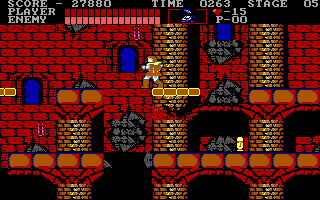
- The 1up pop-up treasure is missing from Stage 5.
-
Some music tracks aren't correctly paired with stages. Wicked Child plays in Stage 4. Walking on the Edge plays in Stage 5. Nothing to Lose is not heard in the final area of Stage 6; instead Out of Time continues to play.
- There's no Game Over music. Upon death, instead, you're taken to the silent high-score screen.
- There are some notable changes to enemy placement. Some are missing from their posts, like the second bone pillar in block 15. And in one particular space--the final leg of Stage 5--two additional axe knights appear.
- Dracula's second form doesn't spew fireballs.
- When you grab the final crystal, it plays the normal stage-clearing theme instead of the more-rewarding All Clear theme.
-
The ending theme, Voyager, is abbreviated, and its final section continues to loop. It continues to do so on the following high-score screen (the "Hall of Blame," as it's called). As the music and the credits seem to line up perfectly in this version, there's no logical reason for why the composer chose to take this route.
- There's no second quest. After you enter your name on the high-score screen, you're immediately taken back to the game's start-or-continue selection screen.


   Soundtrack and Credits
 

Soundtrack

1. Prologue 7. Walking on the Edge 13. Voyager
2. Vampire Killer 8. Heart of Fire 14. Death
3. Poison Mind 9. Out of Time 15. Game Over
4. Stage Clear 10. Nothing to Lose 16. Underground
5. Stalker 11. Black Knight  
6. Wicked Child 12. All Clear  

Links
Music Files: NES version: MP3 (American and Japanese) and MIDI. Commodore 64 version: MP3. Amiga version: MP3. IBM PC / DOS version: MP3.
Soundtrack Release: Dracula Perfect Selection, Akumajou Dracula Best, Dracula Battle Perfect Selection,
Akumajou Dracula MIDI Collection, Castlevania Best Music Collections Box and Castlevania - Original Video Game Soundtrack (30th Anniversary Vinyl Edition)
Game Credits: Available


   Character List
 

Lesser Enemies

Skeleton Zombie Vampire Bat
Fishman Knight Medusa Head
Hunchback Skeledragon Red Skeleton
Ghost Eagle Raven
Leopard Pillar of Bones Axe Knight

Bosses

Phantom Bat Medusa The Mummies
Frankenstein and Igor The Grim Reaper  

Dracula Forms

Dracula Dracula's Ghost