Date Released
Developed By
Published By
June 25th, 1998
KCEN
Konami
Playable Heroes
Stage Number
Game Size
Alucard | Richter Belmont and Maria Renard
30 Castle Sections
402MB
Original Platform
Sega Saturn 


    The Manual's Synopsis
 

As translated by Solar Boy:

"After many battles, Count Dracula, resurrected by the dark priest Shaft, was defeated by Richter Belmont.

However, four years later, on the night of a full moon, Richter mysteriously vanished.

With no idea where to start, Maria Learned set off on a journey to find him, but on the way, as though to indicate his whereabouts, something happened. Castle Dracula, rumored to return but once every hundred years, suddenly appeared.

Meanwhile, something unusual was happening to one man.

His name was Alucard. The same man who once fought alongside Ralph C. Belmont to destroy his father, Dracula.

To put an end to his own cursed blood, he sealed his powers, and entered what should have been an eternal slumber. However, that slumber was disturbed, and he knew that his corrupt homeland had returned.

Now, holding many thoughts, the fated souls gather at Castle Dracula.

Only the moon, rising through the darkness, knows the truth…"

For some notes on this translation, please read Solar Boy's translation file.


   Objective / Overview
 

While the members of the Dracula X team were preoccupied with other projects, it was up to the Konami division KCEN (Konami Computer Entertainment of Nagoya) to live up to the company's promise to port Akumajou Dracula X: Gekka no Yasoukyoku over to the Sega Saturn. While at its root the same experience, KCEN provided to the free-roaming adventure-RPG some exclusive material in terms of enemies, weapons and playability.

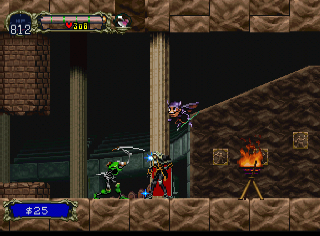
As it was: You play the role of Alucard and must fight your way through the evil-infested Castlevania and its inverted cousin to save the spell-induced Richter Belmont and discover the source of the castles' appearances. You'll travel through thirty castle sections (including four exclusive), therein, and encounter minor enemies and bosses alike, a variety of traps, some puzzles, and finally the game's ultimate evil. You'll enhance the RPG-powered Alucard by gaining levels; by collecting a large amount of weapons, armor and item types (with exclusive entries here, too); by learning and using spells; and by collecting relics that afford increased accessibility, the subservient familiars, and other unique abilities.

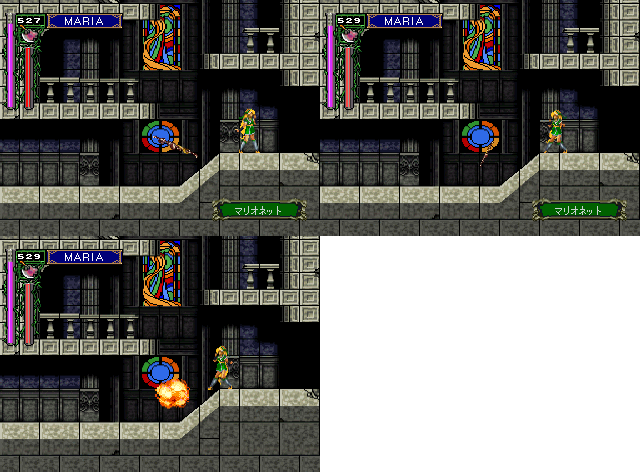
Also exclusive to the Saturn version is the ability to play as both Richter Belmont and Maria Renard from the outset. Richter is what you'd expect if you've unlocked him in the PlayStation version; the only difference here is that he dons an alternate outfit. Maria is overall similar to Richter in terms of mechanics, but, moreover, she's akin to a blend of Alucard and Maxim Kischine from Harmony of Dissonance. Both characters have immediate accessibility due to their loose mechanics, but neither has a relevant story to his or her quest other than the quick one-screen endings received for defeating Shaft in the inverted castle. Additionally, both characters have exclusive themes that play in the Castle Entrance and during boss fights.


   Version Differences
 

Japanese Version
This is the Japanese version, a game with no North American counterpart due to what was becoming the Saturn's slow demise in the west. So it's only fair to list the differences between this and the American version of Symphony of the Night:
- You can play as Richter Belmont from game's start and immediately access the game's name-entry codes.
- You can play as Maria Renard, who didn't appear in Symphony as a playable character.
- Richter and Maria have their own intros and endings.
- Alucard's intro makes reference to "Ralph C. Belmondo" rather than his western-named counterpart, Trevor Belmont. The rest of the intro is worded slightly different than the PlayStation intro.
- There are two new areas not seen in Symphony--the Cursed Prison and the Underground Garden. Each has its own overarching theme. (There are actually four new sections if you count the upside-down versions.)
- The Abandoned Mine is now called "Abandoned Pit to the Catacomb." The Underground Cavern is "Ground Water Vein." And Olrox's Quarters is "Olrox's Room."
- There are sixteen exclusive lesser enemies.
- There are two extra bosses, one of which is located in a new section; the other is Maria.
- Some enemies' death animations differ slightly, like the marionettes that are now pulled back to Hell.

- Richter and Maria have exclusive themes that play as they run through the Castle Entrance.
- The characters are more animated during conversations, like the Master Librarian who hides his face at the thought of helping an outsider.
- There are more equippable weapons to be found.
- The placement of relics is different.
- Like the Japanese PlayStation version, it has those two extra familiars: The "Sprite Familiar" and the "Tengu Goblin."


- Some of the longer rooms have been broken up into two for purposes of loading times.
- Some rooms are missing from the game altogether, like those in the Reverse Cavern that lead to the Force of Echo.


   Soundtrack and Credits
 

Soundtrack

1. Metamorphosis 15. The Master Librarian 29. Blood Relations
2. Prologue 16. Crystal Teardrops 30. Metamorphosis 2
3. Dance of Illusions 17. Enchanged Banquet 31. Final Toccata
4. Moonlight Nocturne 18. Abandoned Pit 32. Lost Painting
5. Prayer 19. Rainbow Cemetery 33. Lost Painting
6. Bloody Tears (Remix 2) 20. Death Ballad 34. Curse Zone
7. Vampire Killer (Remix 2) 21. Bloody Tears (Remix 1) 35. Door of Holy Spirits
8. Dracula's Castle 22. Vampire Killer (Remix 1) 36. The Door to the Abyss
9. Dance of Gold 23. Requiem for the Gods 37. Guardian
10. Festival of Servants 24. Bloody Confession 38. Black Banquet
11. Marble Gallery 25. Dance of Pales 39. Metamorphosis 3
12. Chaconne C'Moll 26. Wandering Ghosts 40. I Am the Wind
13. Tower of Mist 27. The Tragic Prince  
14. Wood Carving Partita 28. Heavenly Doorway  

Links
Music Files: MP3
Soundtrack Release: Regular Soundtrack, Remixed Soundtrack, Dracula X Remixes, MIDI Power Pro 6, Dracula MIDI Collection and Castlevania Best Music Collections Box
Game Credits:
Available


   Character List
 

Lesser Enemies

Blood Skeleton Bat Stone Skull
Zombie Merman Skeleton
Warg Bone Scimitar Merman (II)
Spittle Bone Axe Knight Bloody Zombie
Slinger Ouija Table Skelerang
Thornweed Ghost Marionette
Diplocephalus Flea Man Medusa Head
Blade Soldier Bone Musket Medusa Head (II)
Plate Lord Stone Rose Axe Knight (II)
Ctulhu Bone Archer Bone Pillar
Owl Phantom Skull Scylla Worm
Skeleton Ape Spear Guard Spellbook
Winged Guard Ectoplasm Sword Lord
Toad Armor Lord Corner Guard
Dhuron Frog Frozen Shade
Magic Tome Skull Lord Black Crow
Blue Raven Corpseweed Flail Guard
Flea Rider Spectral Sword Bone Halberd
Hunting Girl Mudman Owl Knight
Spectral Sword (II) Vandal Sword Flea Armor
Paranthropus Slime Blade Master
Wereskeleton Grave Keeper Gremlin
Harpy Bone Ark Valhalla Knight
Cloaked Knight Fishhead Lossoth
Salem Witch Blade Gurkha
Hammer Discus Lord Large Slime
Hellfire Beast Killer Fish Tombstone
Venus Weed Lion Scarecrow
Schmoo Tin Man Balloon Pod
Yorick Bomb Knight Flying Zombie
Bitterfly Jack O' Bones Archer
Werewolf Black Panther Dragon Rider
Minotaur Nova Skeleton Orobourous
White Dragon Fire Warg Rock Knight
Sniper of Goth Spectral Sword (III) Ghost Dancer
Warg Rider Cave Troll Dark Octopus
Fire Demon Gorgon Malachi
Blue Venus Weed Imp Azaghal
Frozen Half Salome Dodo Bird
Guardian Spectre Gargoyle
Will-o-Wisp Skeleton Breeder Skeleton Beast
Water Leaper Gardener Hitotorisou
Red Gargoyle Jinnunja Gargoyle (II)
Wight Wraith Copper Armor
Ifreet Skeleton Guardian

Bosses

Gaibon Slogra Doppelganger10
Scylla Hippogryph Minotaurus
Werewolf Karasuman Olrox
Succubus Granfaloon Darkwing Bat
Akmodan II Doppelganger40 Medusa
The Creature Fake Grant Fake Trevor
Fake Sypha Beezelbub Richter Belmont
Galamoth Death Shaft
Skeleton Leader Maria Renard  

Dracula Forms

Dracula Dracula (II)

Supporting Cast

Maria Renard Death The Ferryman
The Master Librarian Shaft